

Elevator Models: How to Read a BST Express Code
A BST Express model number carries the product line, the rated capacity and the rated speed in four parts, so a code on an offer can be checked without a catalogue being open.
A quotation arrives with one line that reads BST-PAS-1000-1.75. To the buyer it is a string of letters and numbers; to the factory it is a complete instruction — which platform, how much it must lift, how fast it travels. This page explains how BST Express elevator models are put together, so a code on a drawing, a packing list or an invoice can be read without asking anyone.
The rule behind these elevator models is short enough to hold in your head: maker, product line, rated capacity in kilograms, rated speed in meters per second. The rest of this page is the detail behind those four parts — including the one place where the fourth part changes meaning, and the component codes that sit underneath the main number. Once the structure is clear, elevator models from any line can be read at a glance.
- Elevator models: the code, part by part
- Why capacity and speed sit in the number
- The eight product lines and their prefixes
- Passenger and hospital models
- Freight and car elevator models
- Escalators and moving walks
- Component codes inside a model
- What the code does not tell you
- Frequently asked questions
Elevator models: the code, part by part
In short: a BST Express model reads as maker, line, capacity, speed. BST-PAS-1000-1.75 is a passenger elevator rated 1,000 kg with a rated speed of 1.75 m/s. The structure is identical across all eight product lines, so elevator models from this factory can be read without a catalogue in hand.
| Part | In BST-PAS-1000-1.75 | What it states | Values in use |
|---|---|---|---|
| Factory mark | BST | Bsite Express, identical on every unit | Fixed |
| Product line | PAS | Which of the eight lines the unit belongs to | 8 prefixes |
| Rated capacity | 1000 | Rated load in kilograms | 50 to 5,000 kg |
| Rated speed | 1.75 | Rated speed in meters per second | 0.25 to 2.5 m/s |
In elevator models the four parts split two ways: two are decided by the product line and two are decided per project. BST never changes. The three-letter line code changes only when the line changes. Capacity and speed are the two numbers a project actually negotiates, and they are the two that appear in the code. Because each part is decided independently, elevator models can be quoted at a fixed capacity while the shaft is still being measured.
Capacity is written in kilograms with no unit suffix, because the position carries the unit. Speed keeps its decimal point in every code. 1.75 is not the same as 17, and a speed segment that dropped the point would be ambiguous at the top of the range where 2.5 and 25 m/s are not the same machine. Every code in the elevator models list on this page keeps its decimal point for that reason.
Why capacity and speed sit in the number
A serial number would be simpler for the factory and useless for the buyer, so these elevator models are numbered by what the buyer has to check. Putting the two parameters that decide the shaft, the machine and the price into the code means three things can be checked without opening a file.
First, offers can be compared line by line, which is the practical gain from putting parameters into elevator models at all. Two quotations that both say “passenger elevator” cannot be compared; two that say BST-PAS-1000-1.75 and BST-PAS-800-1.0 differ in exactly the numbers that drive cost.
Second, spare parts can be matched to the unit in service years later, without a nameplate reading or a site visit. Third, a drawing can be re-checked after a change: rated capacity and rated speed set the traction machine, the ropes, the safety gear and the counterweight, so a code that carries them is a short record of the design basis.
This is also why elevator models are coded before the drawing is issued rather than after it. Once the capacity and speed are fixed, shaft dimensions, car size and machine selection follow from the standards rather than from preference.
The eight product lines and their prefixes
Each prefix takes the first three letters of the line name. That sounds trivial until a buyer has to guess whether a hospital unit is HOS or MED, or whether a car elevator is CAR or AUT. The rule removes the guess, which matters most when a tender document mixes several suppliers’ references into one table, so a schedule of competing elevator models has to be sorted by supplier before it can be read.
| Product line | Prefix | Example | What the line covers |
|---|---|---|---|
| Passenger elevator | PAS | BST-PAS-1000-1.75 | Offices, hotels, residential towers |
| Hospital elevator | HOS | BST-HOS-1600-1.0 | Bed lifts with stretcher clearance |
| Freight elevator | FRE | BST-FRE-2000-0.5 | Goods lifts with wide, high doors |
| Car elevator | CAR | BST-CAR-3000-0.25 | Vehicle platforms for parking |
| Panoramic elevator | PAN | BST-PAN-1000-1.5 | Glass-walled cars in atriums |
| Escalator | ESC | BST-ESC-1000-30 | Inclined continuous transport |
| Moving walk | MOV | BST-MOV-1400-0 | Level or gently inclined walkways |
| Dumbwaiter | DUM | BST-DUM-100-0.4 | Small service lifts for trays and boxes |
The prefixes are fixed at PAS, HOS, FRE, CAR, PAN, ESC, MOV and DUM. A reference that starts with anything else is not a BST Express model, which is a quick way to spot a mixed-source schedule. Sorted this way, a list of elevator models from a tender becomes eight short columns.
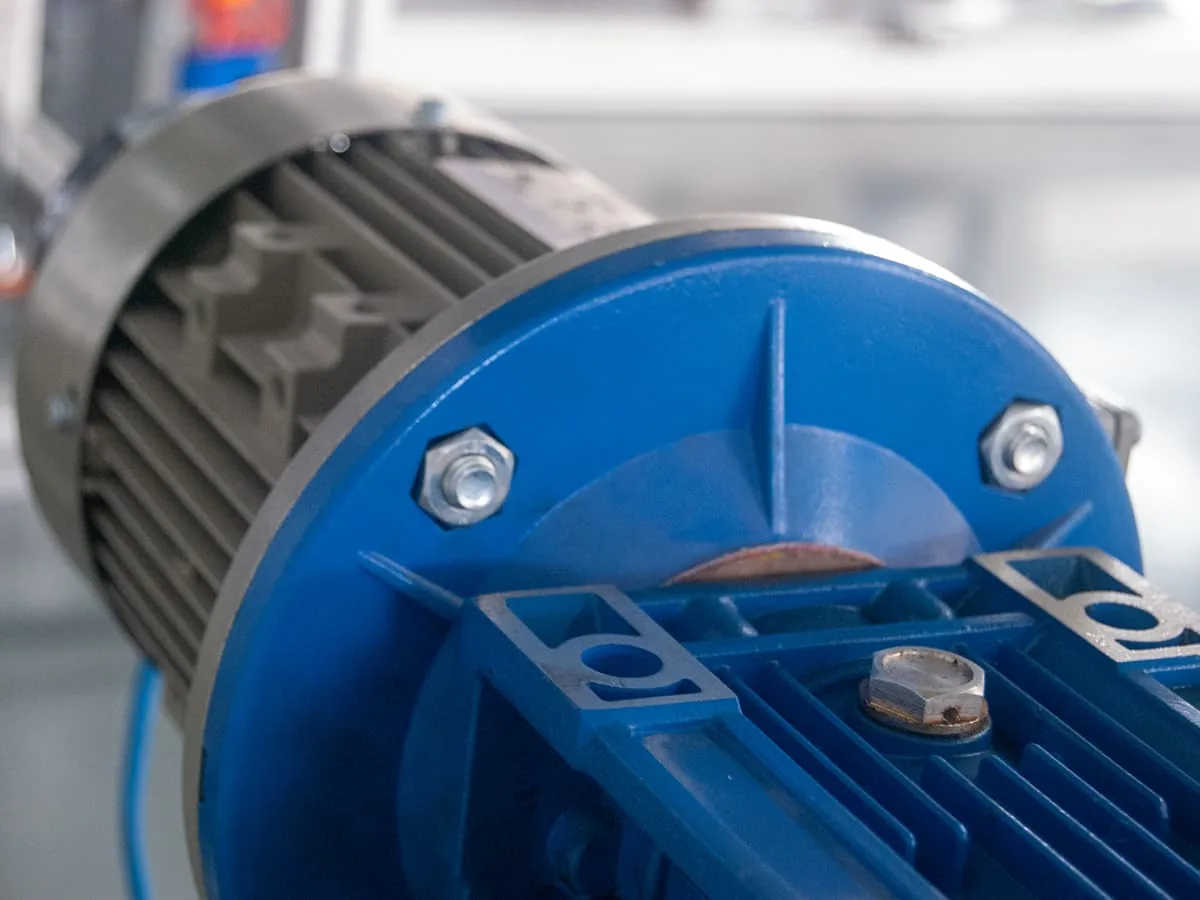
What the prefixes do not show is how much hardware is shared. Traction machines, controllers, door operators and guide rails run across the lines, which is why two elevator models from different lines can share a machine.
What changes between a passenger and a hospital unit of the same capacity is the car, the door clearances and the levelling behavior, not the platform underneath. That shared base is the reason a spare set for one line can often be drawn from stock held for another — and the reason elevator models in this catalogue are configurations of one platform family rather than eight separate products.
Passenger elevator models: BST-PAS
Passenger codes are the widest set of elevator models, and the middle of the range is where most projects land.
| Model | Rated capacity | Rated speed | Rated persons | Typical building |
|---|---|---|---|---|
| BST-PAS-630-1.0 | 630 kg | 1.0 m/s | 8 | Low-rise residential, small office |
| BST-PAS-800-1.5 | 800 kg | 1.5 m/s | 10 | Apartment block, serviced apartments |
| BST-PAS-1000-1.75 | 1,000 kg | 1.75 m/s | 13 | Office, hotel, hospital visitor lift |
| BST-PAS-1250-2.0 | 1,250 kg | 2.0 m/s | 16 | Mid-rise office |
| BST-PAS-1600-2.5 | 1,600 kg | 2.5 m/s | 21 | High-rise office, public building |
| BST-PAS-2000-1.75 | 2,000 kg | 1.75 m/s | 26 | Shopping center, low-rise high traffic |
BST-PAS-1000-1.75 is the single most common code on this line, and it is common for a reason: 1,000 kg covers a full car of office workers, and 1.75 m/s is the fastest speed that still works comfortably in a building of ten to fifteen floors. Below 630 kg the line becomes a residential product with a different door and a smaller shaft; above 1,600 kg the counterweight and machine grow faster than the car does. The four elevator models either side of it exist for buildings that are smaller, faster or more crowded.
For every one of the six elevator models on this line the persons figure is derived rather than chosen. EN 81-20 and its ISO 8100 successor divide the rated load by 75 kg per person and round down, so 1,000 kg is 13 persons and 1,250 kg is 16 (European Commission, lifts). The same standard caps the available car area for each rating: a 1,000 kg car may not exceed 2.40 m² of floor area, whatever the shaft would allow. Shaft and car dimensions for this line are set out on the passenger elevator page.
Hospital elevator models: BST-HOS
Hospital capacity is a bed question before it is a weight question, and that is what separates these elevator models from the passenger set.
| Model | Rated capacity | Rated speed | Rated persons | Typical use |
|---|---|---|---|---|
| BST-HOS-1000-1.0 | 1,000 kg | 1.0 m/s | 13 | Clinic, small ward block |
| BST-HOS-1600-1.0 | 1,600 kg | 1.0 m/s | 21 | Standard bed lift |
| BST-HOS-1600-1.75 | 1,600 kg | 1.75 m/s | 21 | Multi-storey hospital |
| BST-HOS-2000-1.0 | 2,000 kg | 1.0 m/s | 26 | Bed plus equipment trolley |
BST-HOS-1600-1.0 is the reference unit on this line. A hospital bed with a patient and a frame runs to roughly 300 kg over a footprint of two meters, so the limiting dimension is rarely the load — it is the car depth needed to take the bed without angling it, and the door clear opening needed to pass it in a straight line.
In practice that means a car depth of at least 2.4 m and a clear door opening of 1.1 m or more, with the bed entering along the long axis of the car. Elevator models on this line are therefore chosen by car depth before capacity.
Speed is held at or below 1.75 m/s on this line because a bed accelerates badly, and because the stops are short: a hospital lift spends more of its cycle levelling and holding the door than travelling. Levelling accuracy and a long door dwell matter more here than one extra speed step, which is why three of the four elevator models on this line stay at 1.0 m/s. Bed-lift details are on the hospital elevator page.
Freight and car elevator models: BST-FRE and BST-CAR
These two lines trade speed for capacity more openly than any other, and their elevator models are the easiest to place at a glance: the capacity segment climbs while the speed segment falls.
| Model | Rated capacity | Rated speed | Typical use |
|---|---|---|---|
| BST-FRE-1000-0.5 | 1,000 kg | 0.5 m/s | Small goods lift, pallet loads |
| BST-FRE-2000-0.5 | 2,000 kg | 0.5 m/s | Warehouse, back-of-house retail |
| BST-FRE-3000-0.25 | 3,000 kg | 0.25 m/s | Loading dock, heavy pallets |
| BST-FRE-5000-0.25 | 5,000 kg | 0.25 m/s | Industrial, forklift access |
| Model | Rated capacity | Rated speed | Vehicle class |
|---|---|---|---|
| BST-CAR-3000-0.25 | 3,000 kg | 0.25 m/s | Sedan and small SUV |
| BST-CAR-4000-0.25 | 4,000 kg | 0.25 m/s | Large SUV, light van |
| BST-CAR-5000-0.25 | 5,000 kg | 0.25 m/s | Van, pickup, dual parking |
Freight elevator models start at a speed most passenger buyers would reject, and that is correct. A goods lift is loaded at floor level and unloaded at floor level; nobody rides it between stops for comfort. Halving the speed roughly halves the machine power for the same capacity, which is why a 5,000 kg unit at 0.25 m/s is a smaller machine than a 1,600 kg unit at 2.5 m/s. The same logic is why the heaviest elevator models on this page are also the slowest.
Car elevator models are the only codes where the platform, not the car, is the product. The capacity follows the vehicle rather than the passenger count, and two cars can be parked where the platform geometry and the rated load both allow it. The detail that decides the code is the platform clear width and the door clear height, not the finish. Sizes for both lines are on the freight elevator and car elevator pages.
Panoramic and dumbwaiter models: BST-PAN and BST-DUM
The two smallest sets of elevator models sit at opposite ends of the same logic: one is a passenger car with glass walls, the other is a service platform that never carries a person.
| Model | Rated capacity | Rated speed | Rated persons | Typical use |
|---|---|---|---|---|
| BST-PAN-800-1.0 | 800 kg | 1.0 m/s | 10 | Atrium, hotel lobby |
| BST-PAN-1000-1.5 | 1,000 kg | 1.5 m/s | 13 | Retail, mixed-use tower |
| BST-PAN-1600-1.75 | 1,600 kg | 1.75 m/s | 21 | Landmark building, observation deck |
| Model | Rated capacity | Rated speed | Car size | Typical use |
|---|---|---|---|---|
| BST-DUM-50-0.3 | 50 kg | 0.3 m/s | Compact tray car | Bar, cafe, small kitchen |
| BST-DUM-100-0.4 | 100 kg | 0.4 m/s | Standard service car | Restaurant, hotel pantry |
| BST-DUM-200-0.4 | 200 kg | 0.4 m/s | Deep trolley car | Hospital kitchen, canteen |
Panoramic elevator models follow the passenger series with the same capacity and speed pairs, so the difference between BST-PAS-1000-1.75 and BST-PAN-1000-1.5 is the car construction and one speed step, not a different platform. The glass is why the speed is usually one step lower: a glass car is heavier and the wall stiffness that keeps a high-speed car quiet is not available in the same way.
Dumbwaiter codes are the only elevator models that start below 100 kg, and the only one where a person never rides. That single fact removes the car-area rules that constrain every other line and allows a much smaller shaft for the same load. Line pages: panoramic elevator and dumbwaiter.
Escalators and moving walks: where the fourth part changes meaning
Two of the eight lines of elevator models carry no capacity figure, because an escalator is rated by how many people pass a point per hour, not by a load on a platform. For BST-ESC and BST-MOV the third part is the step or pallet width in millimeters and the fourth part is the inclination in degrees. This is the one place in the system where a fourth part reading 30 does not mean 30 m/s. Every other line in the elevator models list carries a capacity segment in that position.
| Model | Step width | Inclination | Rated speed | When it is specified |
|---|---|---|---|---|
| BST-ESC-600-30 | 600 mm | 30° | 0.5 m/s | Severely restricted plan width |
| BST-ESC-800-30 | 800 mm | 30° | 0.5 to 0.65 m/s | Lower footfall, space limited |
| BST-ESC-1000-30 | 1,000 mm | 30° | 0.5 to 0.75 m/s | Commercial standard, rise above 6 m |
| BST-ESC-800-35 | 800 mm | 35° | 0.5 m/s | Short rise, tight plan |
| BST-ESC-1000-35 | 1,000 mm | 35° | 0.5 m/s | Short rise, full width |
| Model | Pallet width | Inclination | Rated speed | When it is specified |
|---|---|---|---|---|
| BST-MOV-1000-0 | 1,000 mm | 0° | up to 0.75 m/s | Level run, retail, space limited |
| BST-MOV-1200-0 | 1,200 mm | 0° | up to 0.75 m/s | Level run with baggage carts |
| BST-MOV-1400-0 | 1,400 mm | 0° | up to 0.75 m/s | Airport, two abreast with carts |
| BST-MOV-1000-12 | 1,000 mm | 12° | up to 0.5 m/s | Inclined run, restricted space |
| BST-MOV-1100-12 | 1,100 mm | 12° | up to 0.5 m/s | Inclined run with shopping carts |
Geometry constrains these elevator models rather than the other way round. A 35° unit is only permitted up to 6 m of rise, above which the inclination drops to 30°. At 30°, speeds above 0.5 m/s require a longer horizontal step run at both ends, and the requirement grows with the speed. That is why the model number carries geometry and the speed is confirmed separately against the rise — the two cannot be chosen independently (CEN-CENELEC publishes the harmonised escalator and moving walk standards behind those limits). Layouts for both lines are on the escalator and moving walk pages.
Component codes inside elevator models
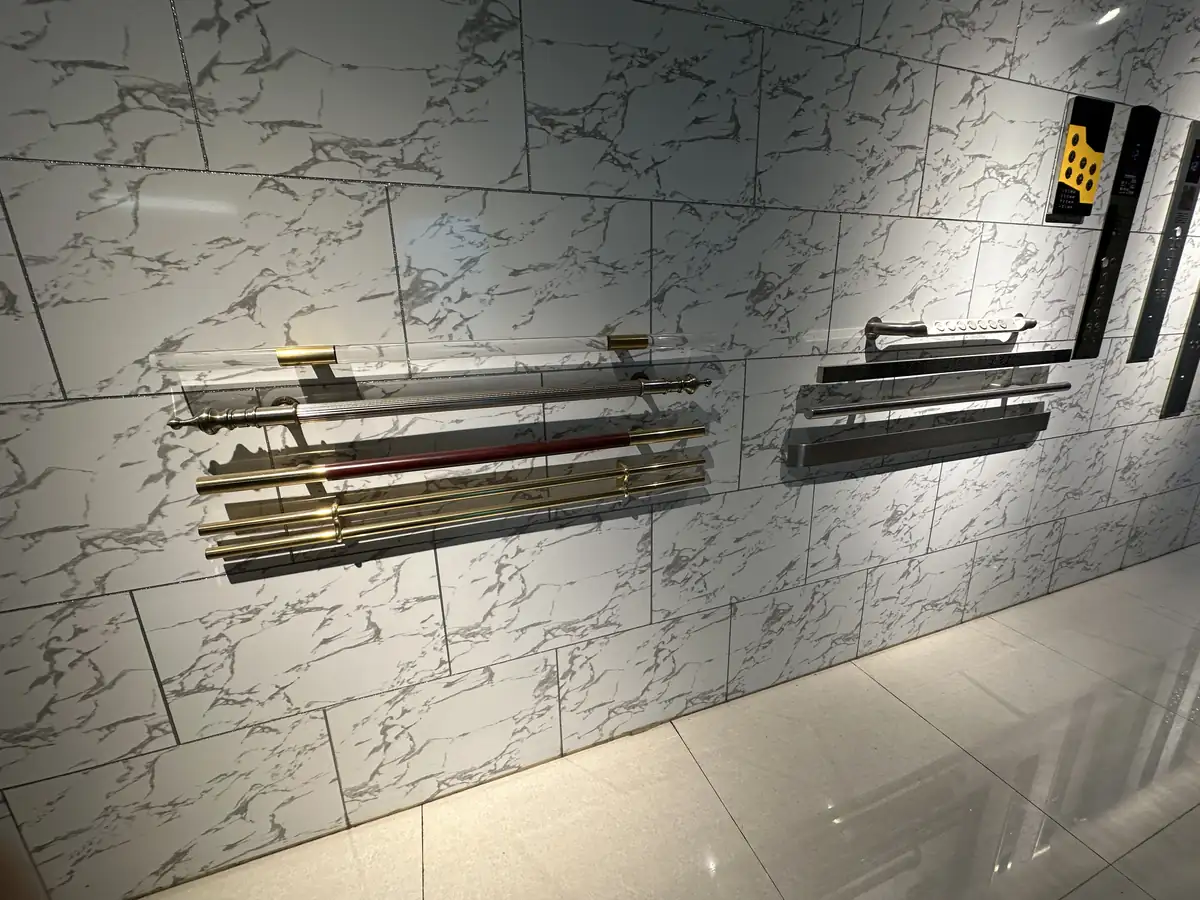
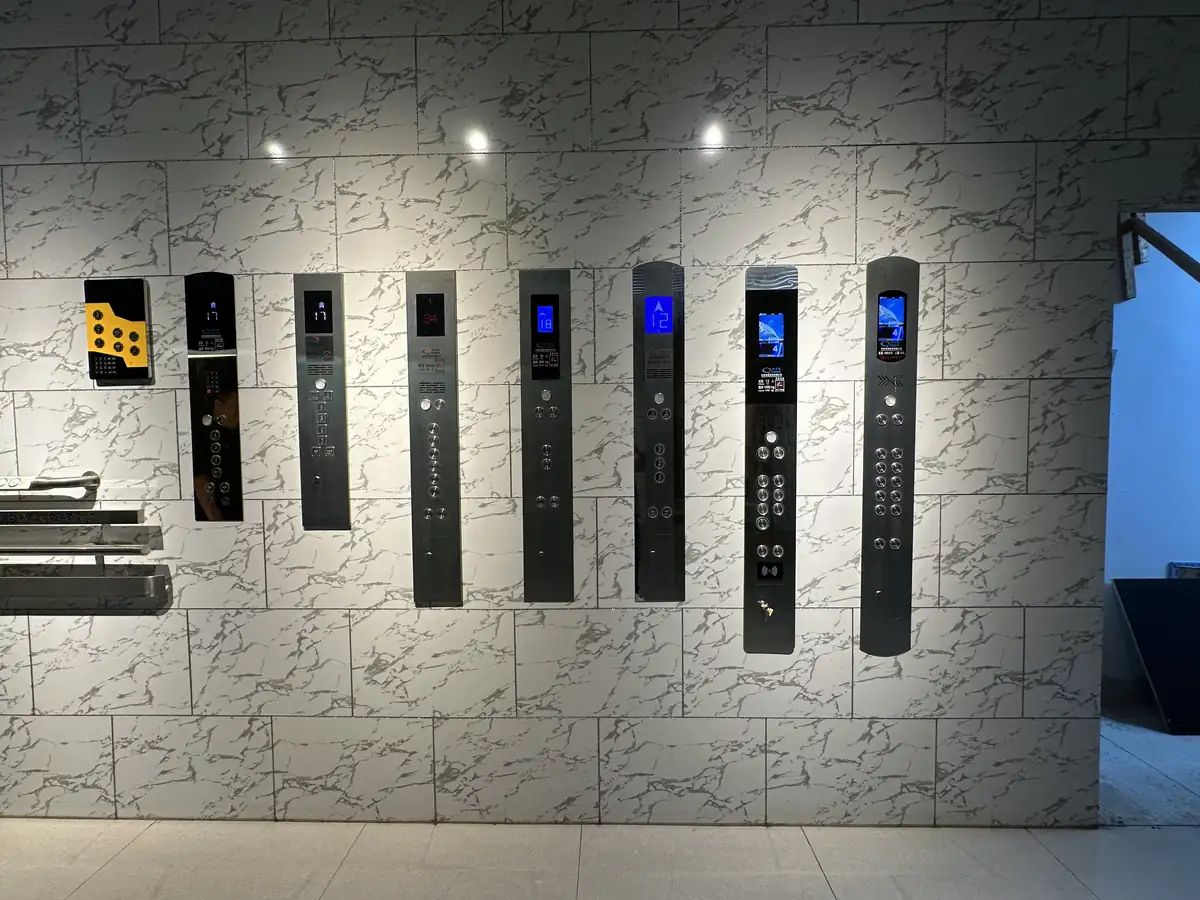
The main number fixes the machine. It says nothing about what the passenger sees, and that is deliberate: finishes are chosen from a library and coded separately, so an order for any of the elevator models on this page has two layers. Each code in that library is a two-letter category plus a three-digit sequence, so BST-CD-002 is the second car decoration in the catalogue, and 002 refers to the same panel set whether it is ordered on a passenger or a hospital unit.
| Code | Category | What it covers |
|---|---|---|
| CD | Car decoration | Wall panels and the finish inside the car |
| CR | Car roof | Ceiling, lighting and ventilation |
| HA | Handrail | Handrail profiles and end fittings |
| FL | Floor | Floor covering and its substrate |
| LD | Landing door | Landing door panels, frames and sills |
| HI | Human interface | Displays, position indicators, landing call units |
| OB | Operation box | Car operating panel and its buttons |
Most categories carry no suffix, because the part is shared across lines. Where a part is line-specific a single letter is added to the sequence: G for panoramic, H for hospital, F for freight. That one letter is the reason a buyer can order what looks like the same handrail for a passenger and a panoramic car of different widths and still receive two different part numbers — the part is the same family, the detail is not. That is how elevator models share a supply chain without sharing every part number.
Floor covering is worth one line of its own, because it is the choice that changes the counterweight. A stone floor can add well over 100 kg to the car, and the balance of the counterweight has to be recalculated before the order is released. Panel materials sit behind most of the remaining choices, and none of them changes the main code — which is why elevator models can look very different on the same line. and the stainless sheet that the panels are cut from is specified to ASTM A240.
Elevator models: what the code does not tell you
A code is a starting point, not a specification, and that applies to every elevator models reference on this page. Five things decide whether a unit can be built at all, and none of them appear in the number.
- Shaft dimensions. Clear width and depth, pit depth and overhead are set by the building, and they cap the car size that any capacity allows.
- Travel and number of stops. The same code serves a four-stop and a twenty-stop building, with different rope lengths, different machine power and a different rope safety factor.
- Door type and clear opening. Center opening, two-panel side opening and four-panel opening share a capacity but not a shaft width.
- Supply voltage and frequency. The controller is built to the site supply, and 380 V, 400 V and 415 V are three different builds rather than one setting.
- Fire, seismic and accessibility requirements. These change the door operator, the car fixtures and sometimes the speed, and they are set by the destination market rather than by the product line.
None of the five can be inferred from the code, and all five are confirmed on the drawing before production. A quotation that carries only a model number is therefore incomplete in a way that is easy to miss. Elevator models are the start of a specification, never the whole of one.

How to quote elevator models in an enquiry
When a code from this list of elevator models goes into an enquiry, four lines should travel with it. None of them is difficult, and all four prevent a round of rework on elevator models of any line.
- Model code, complete: BST-HOS-1600-1.0, not “hospital lift 1600”.
- Travel and stops, in meters and in number: 18.5 m over six stops, not “six floors”.
- Shaft or opening, whatever is fixed: 2,200 × 2,300 mm, or the landing door opening already cast.
- Supply, as it will be measured at the terminals: 415 V, three phase, 50 Hz.
Three habits cause most of the rework on these elevator models. The first is dropping the speed segment, which leaves the machine and the rope ratio open. The second is quoting a capacity without the persons figure, which in a market using a different convention per person produces a car that is legal on weight and crowded in practice. The third is treating the component code as decoration: a floor change that arrives after the counterweight is calculated is a change to the machine, not to the finish.
Frequently asked questions
Can a model code be used on its own as an order specification?
No. The code fixes the line, the capacity and the speed; shaft dimensions, travel, door type, supply and local requirements are all outside it and are confirmed on the drawing.
Do elevator models from different lines share parts?
Yes. Traction machines, controllers, door operators and guide rails are common across the lines, and most component categories carry no line suffix for that reason.
What does the letter after a component number mean?
It marks a line-specific variant: G for panoramic, H for hospital, F for freight. A component code without a letter is used across lines.
Why is 1,000 kg at 1.75 m/s so common?
Because 1,000 kg is 13 persons under the 75 kg convention and 1.75 m/s is the fastest speed that still rides comfortably in a ten to fifteen floor building, so the pair fits more projects than any other.
Is the number in the code the car size?
No, it is the rated load. Car area is capped separately by rated load, so a 1,000 kg car cannot be built larger than 2.40 m² of available floor area whatever the shaft allows.
Can a code be customized?
The capacity and speed pair can be set to what the project needs, and non-standard values are quoted as a derived code rather than an existing one, so the difference is visible on the offer.
The eight lines share one floor, and elevator models from any of them can be seen at the factory before an order is placed. For the production side of the same question — which lines are built, and where — see the elevator manufacturer page.