


Africa freight surcharges for October 2026 arrived in four waves between 15 and 26 October, from CMA CGM, Maersk and Hapag-Lloyd. For an elevator shipment to Africa the amounts run from USD 250 to USD 1,600 per container or TEU depending on destination, and every carrier charges them on the loading date, not the order date.
What this page covers
- What changed on China to Africa lanes in October 2026
- Why the Durban charge moved 10.5 times in eight weeks
- What a surcharge adds to the cost of one elevator
- The loading date is the only date that counts
- Who pays the surcharge under FOB and CIF
- The discharge port changes the number more than the carrier does
- What a buyer can control before the next notice
What Changed on China to Africa Lanes in October 2026
Twelve charge lines took effect this month across three carriers. Africa freight surcharges are not one programme and they do not move together: the amounts differ by origin zone inside China, by destination zone inside West Africa, and by whether the booking is a short-term contract or a spot rate. The table below is the whole month on one page.
| Carrier | Lane, origin to destination | Charged from, loading date | Amount |
|---|---|---|---|
| CMA CGM | China to Durban, South China | 22 Oct 2026, to 31 Oct | USD 1,050 per TEU |
| CMA CGM | China to Durban, North and Central China | 28 Oct 2026, to 31 Oct | USD 1,150 per TEU |
| CMA CGM | China to Dar es Salaam, Tanzania | 15 Oct 2026 | USD 550 to 600 per TEU |
| CMA CGM | China to Mombasa, Kenya | 15 Oct 2026 | USD 800 per TEU |
| CMA CGM | China to West Africa, north zone | 22 Oct 2026 | USD 250 per TEU |
| CMA CGM | China to West Africa, central zone | 22 Oct 2026 | USD 350 per TEU |
| CMA CGM | China to West Africa, south zone | 22 Oct 2026 | USD 550 per TEU |
| CMA CGM | China to Conakry, Guinea, and to Mozambique | 22 Oct 2026 | USD 200 per TEU |
| Maersk | China, Hong Kong, Taiwan to all West Africa ports | 26 Oct 2026 | USD 800 per 20 ft, USD 1,600 per 40 ft and 45 ft |
| Maersk | Vietnam, Indonesia, Malaysia, Singapore, Thailand to West Africa | 3 Nov 2026, Vietnam 4 Nov | USD 600 to 800 per 20 ft, USD 800 per 40 ft |
| Hapag-Lloyd | China, Korea, Japan, Oceania to north west Africa ports | 25 Oct 2026 | USD 400 per TEU |
| Hapag-Lloyd | China, Korea, Japan, Oceania to south west Africa ports | 25 Oct 2026 | USD 800 per TEU |
Two things in that table matter more than the individual numbers. CMA CGM quotes per TEU while Maersk quotes per container, so a 40 ft box at USD 1,600 is USD 800 per TEU and the carriers are closer than the headline suggests. Maersk also excludes spot bookings, so a spot quote will not show the charge until the invoice arrives.
The second thing is the zone split. West Africa is priced in three bands, and quoting the central band for a port in Angola or Cameroon understates the cost by USD 200 per TEU. Every line in the table can be checked against the carrier’s own publication rather than a forwarder summary: CMA CGM lists East Africa in its network notice and Maersk lists West Africa in its announcement.
Why the Durban Charge Moved 10.5 Times in Eight Weeks
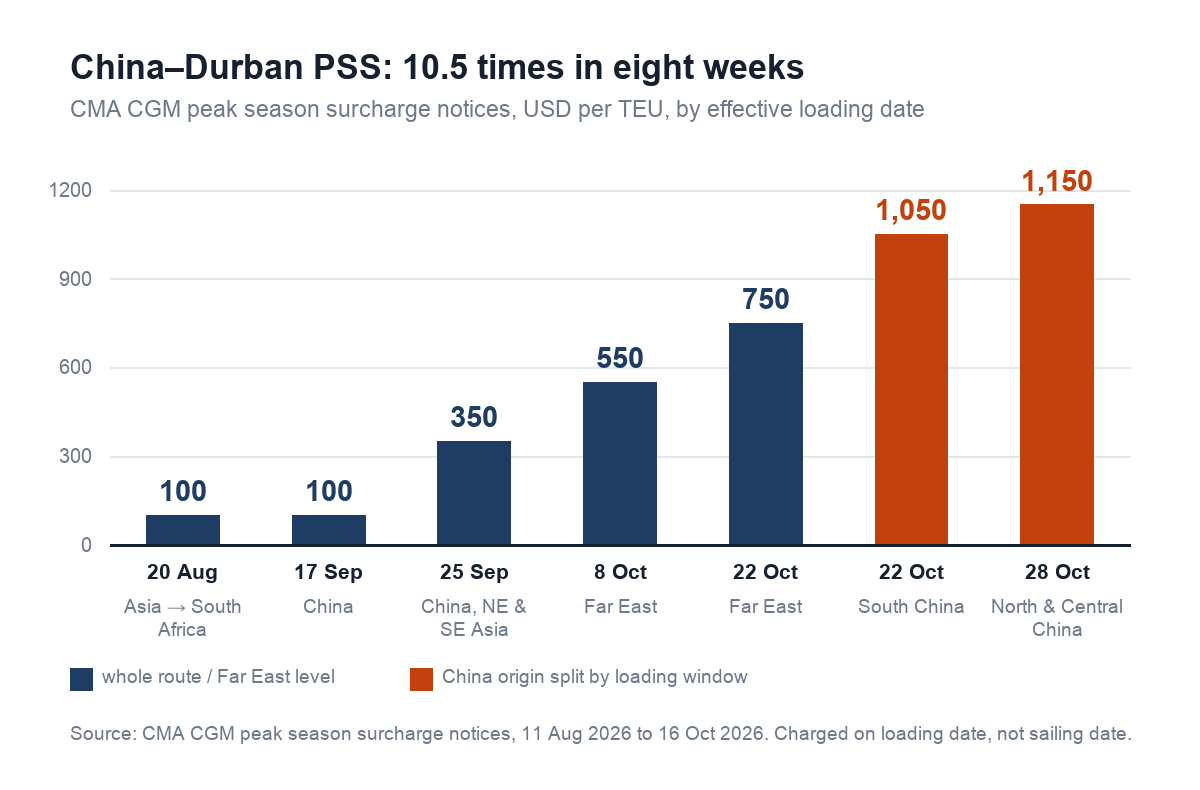
Durban is the clearest case of 2026 because the carrier published six notices in eight weeks and each one superseded the last. Read as a sequence rather than as separate news items, the numbers explain a complaint that reaches every exporter this month: the freight rate in a September quotation no longer matches the November invoice.
| Notice date | Charged from, loading date | Origin scope | PSS per TEU |
|---|---|---|---|
| 11 Aug 2026 | 20 Aug 2026 | Asia to South Africa and Mauritius | USD 100 |
| 10 Sep 2026 | 17 Sep 2026 | China | USD 100 |
| 17 Sep 2026 | 25 Sep 2026 | China, north east and south east Asia | USD 350 |
| 30 Sep 2026 | 8 Oct 2026 | Far East | USD 550 |
| 12 Oct 2026 | 22 Oct 2026 | Far East | USD 750 |
| 16 Oct 2026 | 22 Oct to 31 Oct 2026 | South China | USD 1,050 |
| 16 Oct 2026 | 28 Oct to 31 Oct 2026 | North and central China | USD 1,150 |
Africa freight surcharges of this kind are not a single event but a ratchet. A buyer who agreed freight at USD 100 per TEU in August is now looking at USD 1,050 for the same box from the same port, and nothing about the elevator changed. The figures are published per notice and can be traced one by one in the trade press record.
One limit has to be read into that table. The notice dated 16 October applies only to loading dates between 22 and 31 October, so it says nothing at all about November. Do not extend it into a budget and do not let a supplier extend it into a fixed offer; wait for the next notice and price against the one that is actually in force.
What a Surcharge Adds to the Cost of One Elevator
Africa freight surcharges quoted per TEU tell a buyer nothing until they are divided into the machine being bought, and the only honest divisor is the container space one unit occupies. A standard passenger car with its rails and doors usually fills a 40 ft container on its own, while a small service unit or a dumbwaiter can share one with several others.
| Container space used by one elevator | Durban USD 1,050/TEU | West Africa USD 550/TEU | West Africa USD 350/TEU | West Africa USD 250/TEU |
|---|---|---|---|---|
| 1 TEU, half of a 40 ft container | 1,050 | 550 | 350 | 250 |
| 2 TEU, one full 40 ft container | 2,100 | 1,100 | 700 | 500 |
| 4 TEU, two 40 ft containers | 4,200 | 2,200 | 1,400 | 1,000 |
Take a mid-rise passenger unit that needs one full 40 ft container to itself. At the Durban level of USD 1,050 per TEU the surcharge adds USD 2,100 to that one machine, before ocean freight is counted. The same unit to a south zone West African port adds USD 1,100, and to a north zone port USD 500. That spread is usually wider than the difference between two quotations.
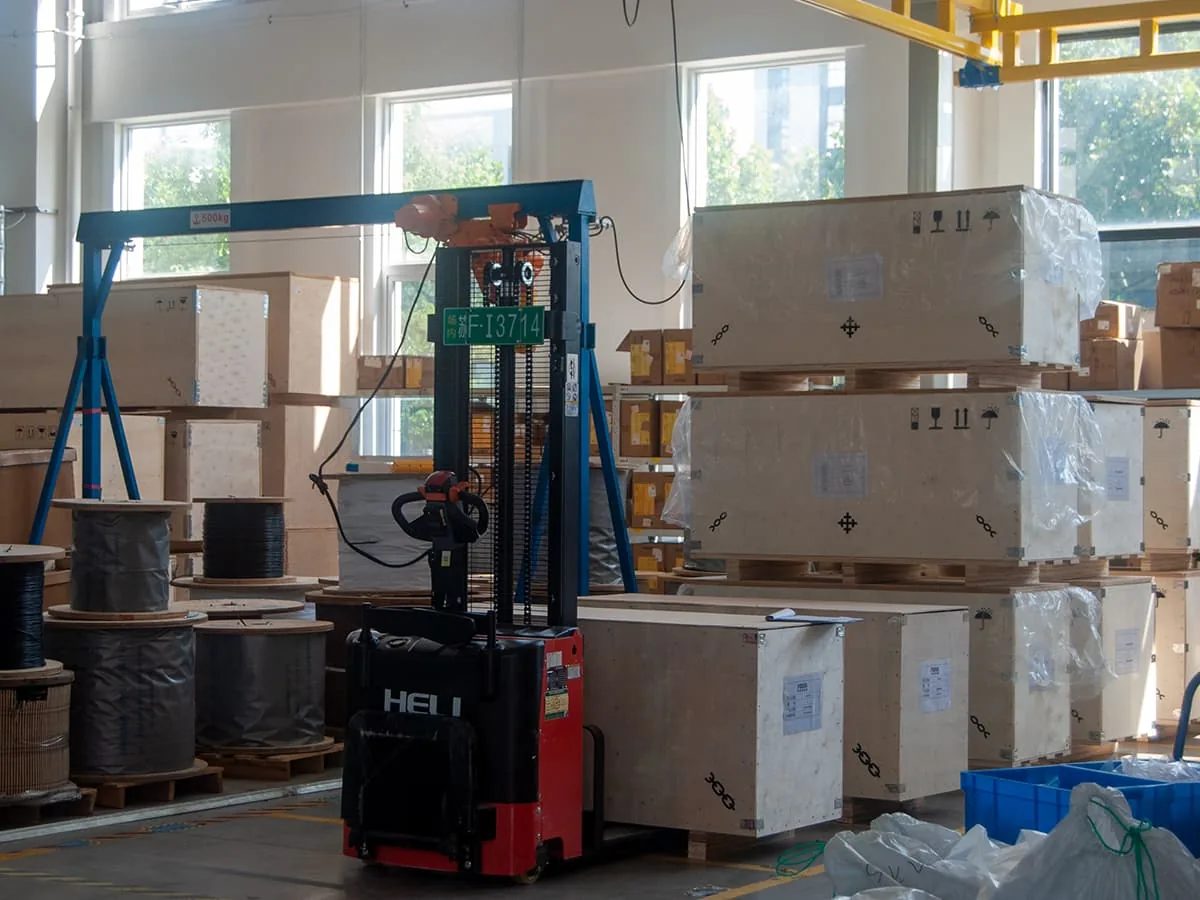
The way to shrink the per-unit figure is to shrink the space, not to argue about the rate. Smaller cars, knocked-down door frames and nested rails shorten the cargo and can move a unit from two TEU to one. How that packing is actually done is a separate subject and is covered in how an elevator is packed into a shipping container.
The Loading Date Is the Only Date That Counts
Every notice in this round names a loading date, not a sailing date and not a booking date. On the South China to Durban lane that single day is worth USD 500 per TEU: a container loaded on 21 October falls under the earlier USD 550 level, and the same container loaded on 22 October falls under USD 1,050. On a 40 ft box that is USD 1,000 for one day of slippage. That single date is what makes these Africa freight surcharges so hard to hold in a budget.
Three dates therefore have to line up before a box leaves: the day production finishes and the unit is crated, the day the truck delivers to the terminal, and the day the container is loaded on board. Most projects plan the first and hope the other two follow. When completion sits within a week of a surcharge change it is worth asking the forwarder whether the earlier cut-off is still open, because moving the truck one day earlier can cost less than any negotiation.
Maersk adds a second layer. Its notices price against the price calculation date at booking confirmation, which for a non-FMC shipment is the scheduled departure of the first water leg, and the charge does not apply to spot bookings at all. A buyer comparing carriers has to compare the date basis as well as the amount, or the cheaper headline can produce the more expensive invoice. The production side of that calendar is set out in how elevator lead time is measured.
Who Pays the Surcharge Under FOB and CIF
On FOB terms the buyer pays ocean freight and everything charged with it, so these Africa freight surcharges land on the buyer’s account even though the seller books the space. On CIF terms the seller pays freight to the destination port and absorbs the increase unless the contract says otherwise. That is why a CIF quotation issued in August can look unprofitable in November without anyone having made a mistake.
Three sentences in the purchase order settle it. The first states that peak season surcharges are billed at the amount published by the carrier for the actual loading date, supported by the carrier notice. The second sets a validity period for the freight component, thirty days being normal on this trade. The third names who absorbs a change that takes effect between booking and loading. Without the third, the first two are arguments rather than terms, and a fixed freight figure becomes a promise nobody can keep.
Incoterms decide more than freight, and the full comparison for an African project sits in importing elevators from China to Africa. The line-item structure that keeps freight and equipment on separate rows is in the elevator quotation checklist.
The Discharge Port Changes the Number More Than the Carrier Does
Mombasa is charged at USD 800 per TEU from every origin zone in China, while Dar es Salaam is USD 550 from South China and USD 600 from the north and centre. For an inland project in Uganda, Rwanda or eastern Congo both ports are realistic, and a USD 200 to 250 difference on the ocean leg can be given back or doubled on the inland haulage. Decide the port on the total.
West Africa repeats the split inside one coast, and Africa freight surcharges follow it. CMA CGM separates the north zone at USD 250, the central zone at USD 350 and the south zone at USD 550 per TEU, so Lagos and Douala are not the same number and Angola is not the same number as Ghana. Hapag-Lloyd draws the line differently, at USD 400 for north west ports and USD 800 for the south west group. A quotation that says only West Africa has not been priced yet.
What a Buyer Can Control Before the Next Notice
No importer can negotiate these Africa freight surcharges away, and a supplier who promises a fixed freight number for the next quarter is guessing. What can be controlled is where the exposure sits and how early it becomes visible.
- Write the billing basis into the order. Actual carrier amount for the actual loading date, with the notice attached to the invoice.
- Ask for the surcharge as a separate line. An all-in freight number hides the one component that moves, and hides it in both directions.
- Check the loading window when production is booked. A completion date inside a surcharge change week is a decision point, not a detail.
- Reduce the space per unit where the model allows. Knock-down frames and nested rails move the per-unit table more than a rate argument does.
- Compare ports on total inland cost. The cheaper ocean leg is not always the cheaper delivered machine.
For a buyer fitting out several floors of freight equipment, the same calculation repeats once per container, and the jump from one 40 ft box to two dwarfs everything else in this article. That is why the packing drawing is worth arguing about at quotation stage, and the port and loading date afterwards. BST Express Elevator quotes freight as a separate line for that reason, against the freight elevator range and the destination port in the enquiry.
Frequently Asked Questions
These are the five questions importers asked most often about Africa freight surcharges this week. The answers apply to the October 2026 notices and should be rechecked against the next carrier publication before a budget is fixed.
Are Africa freight surcharges included in my elevator quotation?
Usually not as a fixed figure. A good quotation lists ocean freight as a separate line and states whether peak season surcharges are included or billed at the carrier amount for the loading date. Ask which of the two applies before comparing totals, because an all-in number can hide a USD 1,050 per TEU charge.
Why did the freight cost rise after my booking was confirmed?
Because Africa freight surcharges are fixed by the loading date, not the booking date. If the container is loaded after a notice takes effect, the new amount applies even when the booking was confirmed weeks earlier. On the South China to Durban lane that gap is USD 500 per TEU between 21 and 22 October.
Is a peak season surcharge charged per container or per TEU?
Both exist and the difference matters. Africa freight surcharges can be quoted either way: CMA CGM publishes per TEU, so a 40 ft container costs twice the published figure. Maersk publishes per container, at USD 800 for a 20 ft and USD 1,600 for a 40 ft or 45 ft, which is the same USD 800 per TEU once converted.
Can I avoid the October 2026 Africa freight surcharges?
Not by negotiating with the carrier. An importer can load before a notice takes effect, choose a destination port in a lower zone, or reduce the container space a unit occupies. Each of those changes the number by hundreds of dollars, which is more than a freight argument usually recovers.
Who pays the surcharge when the order is on FOB terms?
The buyer, because FOB leaves ocean freight and its surcharges on the buyer’s account. On CIF the seller pays to the destination port and absorbs the increase unless the contract passes it on. Either way the purchase order should name who absorbs a change between booking and loading.
The number worth carrying out of this month’s Africa freight surcharges is not USD 1,150. It is the ratio between the cheapest and the dearest lane in the same week, which on these notices runs from USD 250 to USD 1,600 per container. Port, zone and loading date move that ratio; the machine inside the box does not. Buyers who price the route before they price the equipment get a more accurate total, and they get it while the loading window can still be changed.
[…] move inside a quarter, the amount depends on the loading date rather than the booking date, and how the October 2026 Africa freight surcharges convert into a per-machine cost works through that arithmetic port by […]