


Elevator shipping container planning decides whether an imported lift arrives intact. Three things carry that outcome: the box size chosen (20GP, 40GP or 40HQ), the crating standard applied to cabs, rails and machinery, and the lashing pattern used inside the box. For a standard 1,000 kg passenger lift, BST Express Elevator plans the elevator shipping container load as seven documented steps.
Most damage claims on imported lifts do not begin at sea. They begin on the loading bay, where a cab is stacked on its side, a control cabinet sits loose beside a rail bundle, or a guide rail order is loaded without blocking. An elevator shipping container accelerates in six directions at once, and anything inside that can shift will shift, usually within the first hours of the voyage.
This guide follows one export order from the packing list to the sealed door: how each component is protected, which box size fits which product, the checks made during loading, the documents that travel with the goods, and the mistakes that turn a clean shipment into an insurance file.
- What happens between order confirmation and departure
- How an elevator is packed before loading
- Crate standards, ISPM 15 and fumigation
- Choosing the right elevator shipping container
- How an elevator shipping container is loaded, step by step
- Lashing, blocking and bracing inside an elevator shipping container
- Documents you must receive with the shipment
- Seven loading mistakes that cost importers money
- Ports, transit times and Incoterms
- Frequently asked questions
What Happens Between Order Confirmation and Departure
A lift order moves through a fixed sequence, and shipping is the last third of it. Production of a standard passenger unit normally runs 25 to 35 working days after the approved drawings come back, so the elevator shipping container is booked roughly two weeks before that date. The stage-by-stage day counts behind that window, and what moves them, are covered in this guide to how long an elevator takes to build. Carriers release space against a weekly cut-off, and a missed cut-off costs a full week rather than an afternoon.
Crating starts after the unit passes its works test. Cab, doors, machine, controller and rails are packed as separate loads, each with its own weight and centre of gravity noted on the packing list. That list is what the loading supervisor works from, and it is also the first document a surveyor reads when a claim is filed months later.
Loading takes one day for a single elevator shipping container and two for a multi-box order. The elevator shipping container is weighed after loading, the seal number is written into the bill of lading instructions, and photographs of the closed door with the seal visible are sent to the buyer the same day. From that moment the goods are the carrier’s responsibility under the agreed Incoterm.
How an Elevator Is Packed Before Loading
Packing follows the fragility of each part rather than the value of the contract. A cab is a large, light shell that dents easily; a rail is a long steel section that bends if it is supported at the wrong points; a controller is a cabinet of electrical components that fails from moisture long before it fails from impact. Each part needs different protection.
| Component | How it is packed | Why it is packed that way |
|---|---|---|
| Cab walls, ceiling and panels | Protective film on the finished face, then foam sheet, then stretch wrap, with corner boards on every edge | Mirror-finish stainless scratches against anything harder than cloth, and a scratched panel cannot be polished out on site |
| Guide rails and brackets | Banded into matched bundles, supported along the full length at close intervals | A long steel section supported only at the ends sags under its own weight across the box |
| Control cabinet and wiring | Separate case, bolted to the case floor, desiccant inside, no stacking on top | Electrical components fail from condensation rather than from shock |
| Traction machine and governor | Separate case with marked lifting points, anti-rust coating on machined faces | The centre of gravity sits off centre and the machined faces rust in humid air |
| Landing doors and frames | Sorted by floor, numbered, stacked flat with interleaved packing | Installation follows floor order, and unnumbered doors are re-sorted on site at cost |
| Hardware, sills and spares | Cartons divided into compartments, each labelled with its position reference | Loose small parts are the most common shortage item on a delivery |
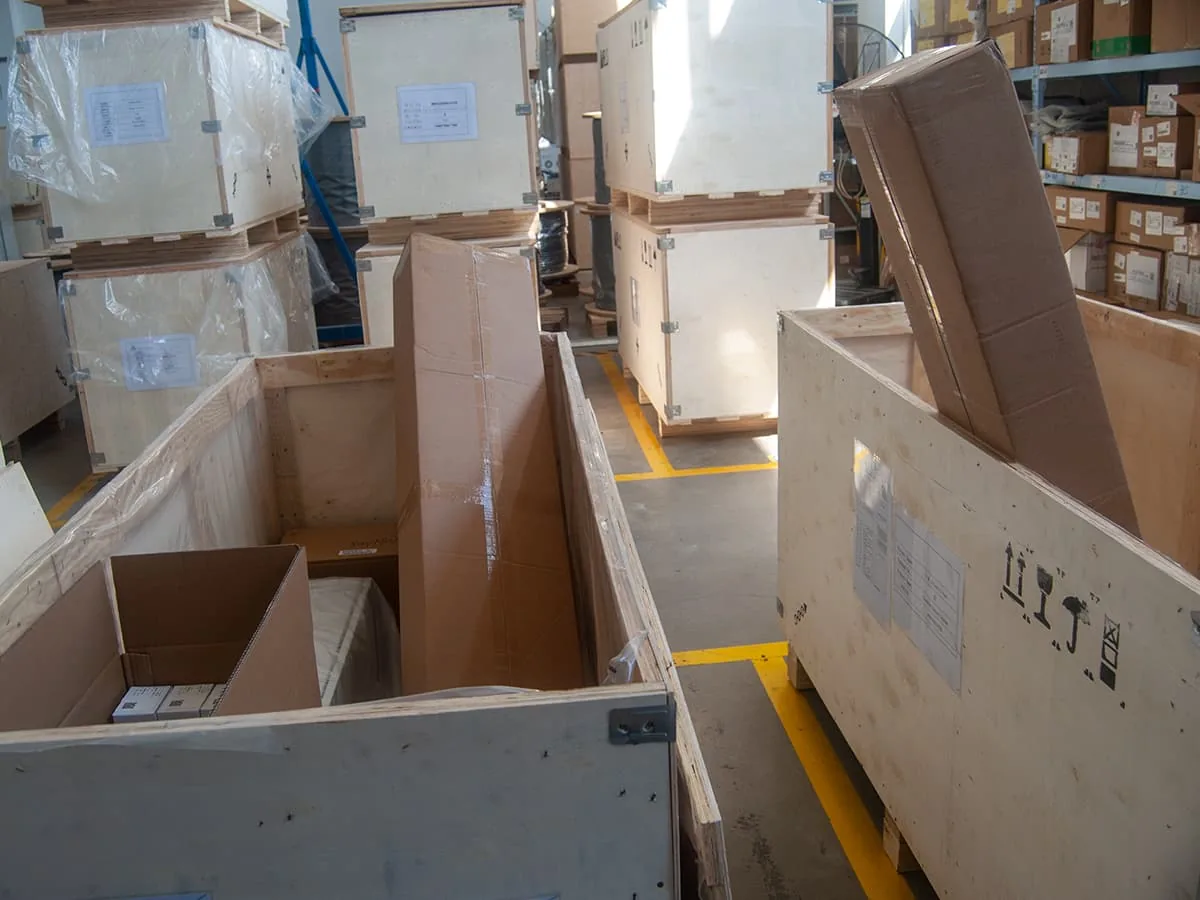
The cab interior is the part buyers forget. Mirror-finish panels scratch against anything harder than cloth, so the inner surfaces are covered before the outer wrap goes on. Handrails, ceiling panels and door sills travel inside the cab as a numbered set instead of loose in the elevator shipping container, which removes one of the most common sources of transit damage. Cab geometry itself is set at the design stage, and the elevator car dimensions guide covers how the car size is fixed against the shaft.
Rails travel as matched bundles, banded at close intervals and supported along their length so that no single span carries the load. A bundle supported only at its ends will sag across a 12-metre box, and a bent rail cannot be straightened on site without losing the alignment tolerance the running clearance depends on.
Machinery travels in its own case. The traction machine, the overspeed governor and the control cabinet are bolted to the case floor rather than stacked, and the case carries marked lifting points. An elevator shipping container loaded this way can be unloaded with a forklift at the destination without opening anything except the doors.
Crate Standards, ISPM 15 and Fumigation
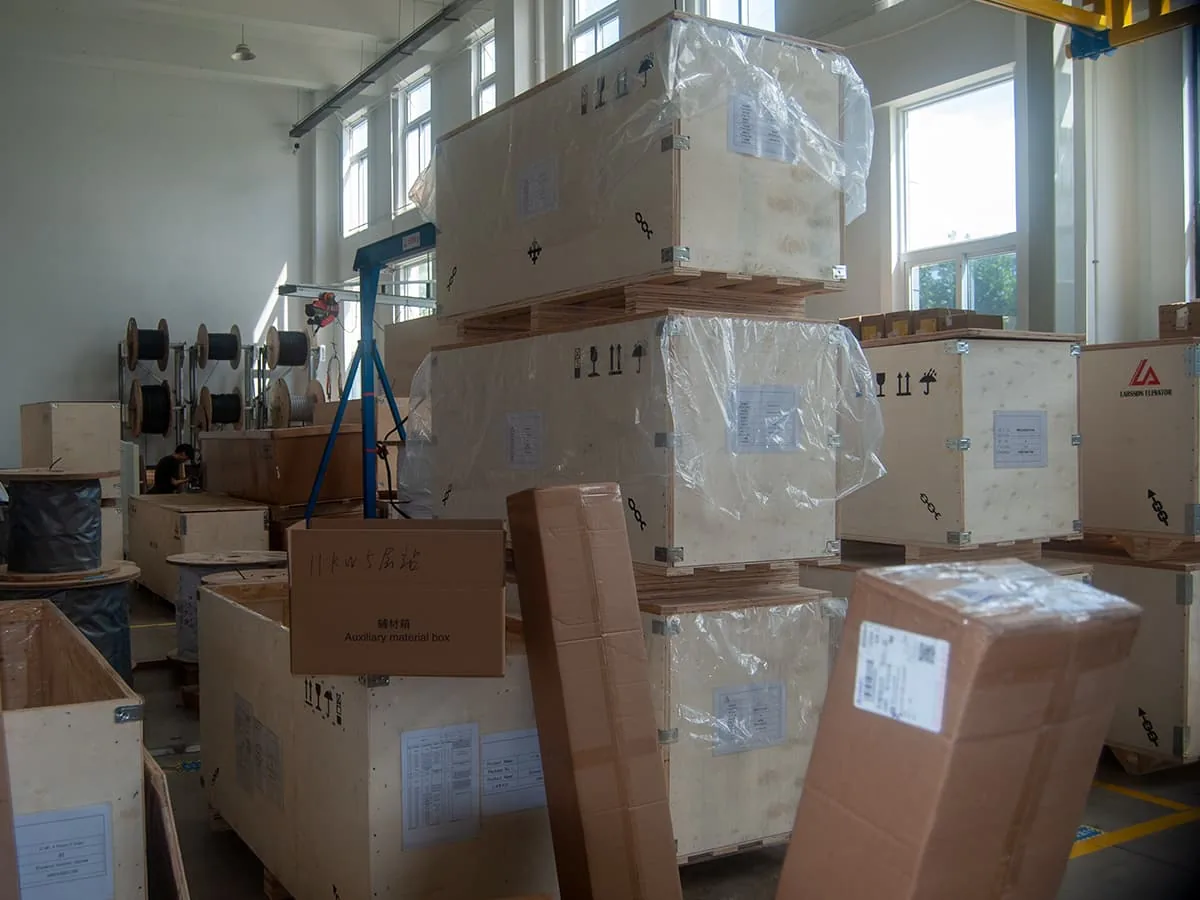
Solid wood packing is regulated, and this is the rule most first-time importers meet at the port rather than at the works. ISPM 15 requires every piece of solid wood packaging above 6 mm thickness to be heat treated to a core temperature of 56 degrees Celsius for at least 30 minutes, or fumigated, and then stamped with the IPPC mark showing the country code, the producer code and the treatment applied.
Plywood, oriented strand board and processed panels are exempt, because the process that makes them destroys the pests the standard targets. A crate built entirely from plywood therefore travels without a stamp, while a crate built from solid timber needs a legible mark on every visible face of every piece of wood in it.
The penalty for a missing stamp is not a fee paid at leisure. The elevator shipping container is held at the port of entry, the wood is re-treated, returned or destroyed at the importer’s cost, and the lift inside waits in a bonded area for weeks. The standard itself is published by the International Plant Protection Convention, and the mark is checked before the container is released rather than after.
Crate design follows the same logic as packing. The base takes a forklift from any of four sides, the walls are braced against racking rather than compression, and the lid is screwed down so a customs officer can open the case and close it again. Access without destruction is the mark of a crate built by a supplier who ships regularly, and it is worth asking for a photograph of one before an order is placed.
Choosing the Right Elevator Shipping Container
Choosing an elevator shipping container is an arithmetic problem before it becomes a cost problem. Three sizes cover almost every lift, and the difference between them decides whether a cab travels upright or has to be tilted, and whether a rail bundle needs a second box. External dimensions are the same for all three, so the decision turns on internal height and the door opening.
| Size | Internal length x width x height | Internal volume | Door opening (width x height) | Usually carries |
|---|---|---|---|---|
| 20GP | 5.90 m x 2.35 m x 2.39 m | About 33 m3 | 2.34 m x 2.28 m | Rail bundles, brackets, landing doors, spares |
| 40GP | 12.03 m x 2.35 m x 2.39 m | About 67 m3 | 2.34 m x 2.28 m | A cab laid flat with doors and controller, short travel |
| 40HQ | 12.03 m x 2.35 m x 2.70 m | About 76 m3 | 2.34 m x 2.59 m | A cab upright with machine, doors and part of the rails |
Internal height is the field that matters most. A 40HQ is roughly 305 mm taller inside than a 40GP, and that clearance is often what allows a passenger cab to be shipped upright with its ceiling panel attached instead of lying on its side. Upright travel is not cosmetic: a cab lying down puts its door sill and wall panels in a direction they were never designed to carry load.
Weight, not volume, sets the limit on rail-heavy orders. Guide rails and machine beams are dense, and a 20GP of rails can reach its permitted gross weight while the box is still half empty. Splitting a rail order across two 20GP boxes sometimes costs less than a single 40GP that cannot legally be loaded, which is why the booking agent should be told the cargo weight before space in the elevator shipping container is reserved.
A complete passenger unit at 1,000 kg duty normally fills one 40HQ once the cab, doors and machine are included, with the rails either sharing that elevator shipping container or taking a second one on longer travel. BST Express Elevator chooses a 40HQ for a 1,000 kg passenger unit so the cab travels upright, and confirms the box count against the crated packing list before booking. Freight units behave differently because the platform and the heavier car frame change both the volume and the weight, and the freight elevator range shows what that means for a single box.
How an Elevator Shipping Container Is Loaded, Step by Step
Loading follows a fixed order, and the reason for that order is the load path along the elevator shipping container floor. An elevator shipping container floor is rated for a distributed load, not for a point load, so the heaviest items go in first and low, and everything after them is placed so it cannot move forward under braking.
- Inspect the elevator shipping container: floor, side walls, roof, door seals and the CSC plate.
- Sweep and dry the floor, then lay a moisture barrier if the route crosses a humid zone.
- Load the machine case against the front wall and block it so it cannot shift forward.
- Load the rail bundles along one side, resting on timber dunnage at regular intervals.
- Load the cab upright, with its own blocking at the base and the door opening braced.
- Load doors, frames and hardware into the remaining space, filling voids so nothing slides.
- Lash, photograph the lashing, weigh the elevator shipping container, close the doors and record the seal number.
Each step produces a photograph, and the set is what a surveyor asks for when a claim is filed. An elevator shipping container that leaves the works with seven documented steps is straightforward to defend; one that leaves with a seal photograph alone is not, whatever the quality of the packing inside it. The commercial terms that govern the rest of the journey are set out in the elevator quotation checklist, which is worth reconciling against the packing list before the box is booked.
Lashing, Blocking and Bracing Inside an Elevator Shipping Container
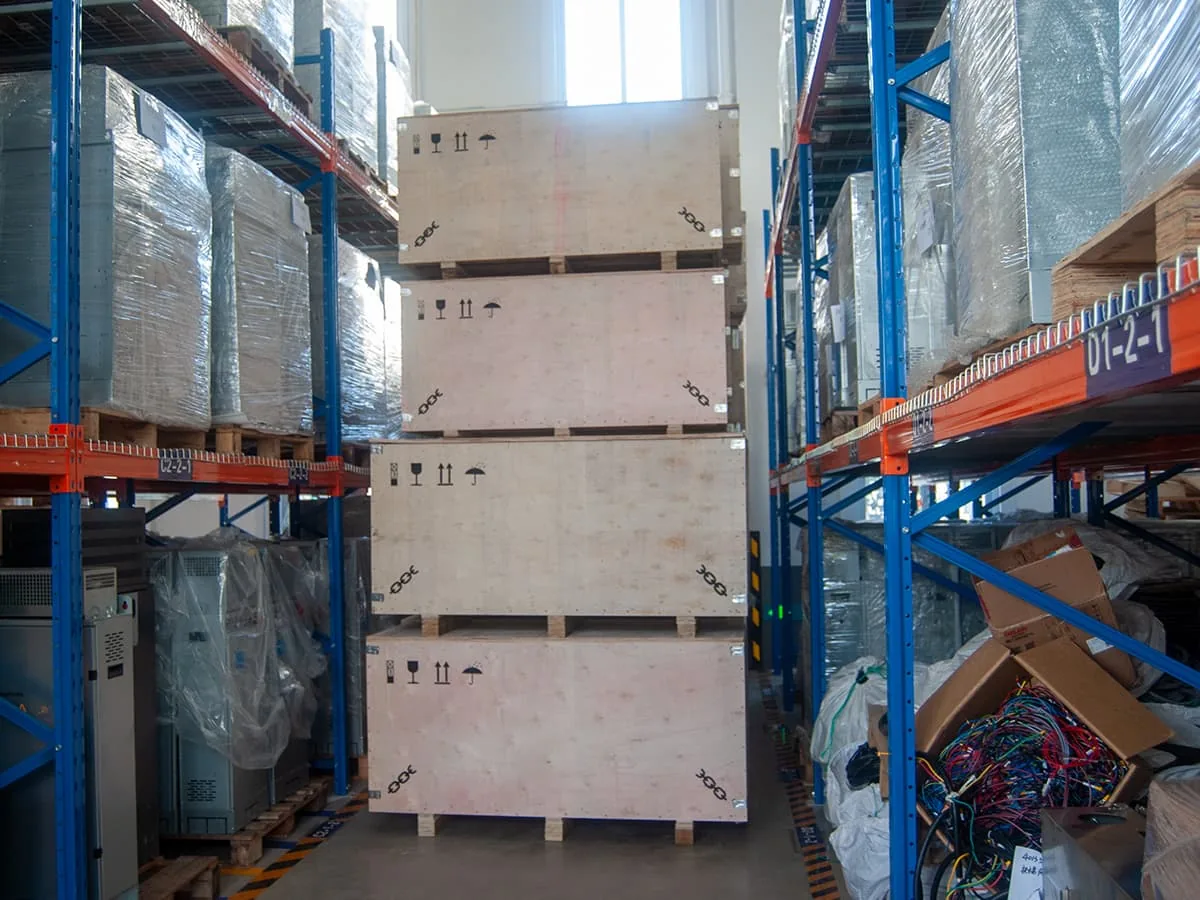
Lashing inside an elevator shipping container holds cargo down, while blocking stops it moving. Both are needed, and the sequence matters: blocking is placed first and the lashing is then tensioned against it. Timber in compression resists a load far better than a strap in tension across an unsupported gap.
Ratchet straps on their own are not enough for a cab. A cab weighs several hundred kilograms, and its panels flex when a strap is tensioned to a single point on the frame. Load-bearing blocking at the base, cut to the height of the floor rail, transfers the load into the elevator shipping container floor where the structure is designed to accept it.
Three lashing patterns cover most elevator shipping container loads: diagonal lashing from the container anchor points to the top of the case, cross lashing between opposite anchors, and direct blocking against the side walls with timber cut to length. A fourth tool, the inflatable airbag, fills awkward gaps and is common on shipments of doors and lobby panels.
The elevator shipping container’s anchor points are rated, and their positions follow ISO 1496-1 rather than the nearest convenient hole. Working to those points is the difference between a lashing that is inspected and accepted at the destination and one that is cut away at the port because it bears on a panel. Corrugated side walls carry almost no inward load, which is why blocking is built against the floor rail and the corner posts.
The loading guidance behind these patterns is published by the International Maritime Organization in the CTU Code, and it applies to every elevator shipping container moving by sea.
Documents You Must Receive With the Shipment
A lift shipment travels with a document set, and each document has a different author and a different purpose. The customs broker works from that set, and a single missing page stops the elevator shipping container at the port of entry however well the goods were packed.
| Document | Who issues it | What it is used for |
|---|---|---|
| Commercial invoice | Supplier | Value declared to customs and payment against the agreed terms |
| Packing list | Supplier | Line-by-line contents, weights and package numbers for unloading |
| Bill of lading | Carrier or forwarder | Contract of carriage and document of title, released against payment |
| Certificate of origin | Chamber of commerce or authority | Preferential duty where a trade agreement applies |
| Fumigation or heat treatment certificate | Accredited treatment provider | Evidence behind the IPPC mark on solid wood packing |
| Test certificate and CE file | Supplier and notified body | Compliance evidence for the lift and its safety components |
| Insurance certificate | Buyer’s insurer | Cover from the point risk passes under the agreed Incoterm |
The invoice and the packing list must match line by line. A discrepancy between them is the most common single cause of a customs hold, and it usually begins with a specification change that reached the factory after the invoice was issued. Any change made after booking should appear on a revised invoice before the elevator shipping container leaves the works.
The same discipline applies to the marks on the goods: a shipping mark is read once at the port, while a nameplate has to carry the Saudi importer’s registered name and CR number from 1 October 2026, which is why a shipping label is not a nameplate for a Saudi order.
Customs classification is the importer’s responsibility, and the tariff lines follow the Harmonized System maintained by the World Customs Organization. Passenger and goods lifts normally fall in one heading while escalators and moving walks fall in another, and that matters when a shipment mixes product categories under one invoice.
On FOB terms the buyer also needs the booking confirmation, the container number, the seal number and the vessel schedule in time to place insurance. Cover arranged after departure is cover that does not apply to the part of the voyage already completed, and an elevator shipping container full of finished panels is worth insuring from the moment it leaves the factory gate rather than the moment it reaches the terminal.
Seven Loading Mistakes That Cost Importers Money
Claims on lift shipments cluster around a small number of avoidable errors. Each of the seven below appears often enough to have earned a line on the loading checklist used at the works.
- Booking an elevator shipping container before the packing list exists. The box count is decided by the crated volume, not by the sales drawing, and the difference between the two is often a second container.
- Loading a cab on its side. Door sills, wall panels and the ceiling frame were not designed to carry the cab’s weight in that direction.
- Supporting rails at two points only. A 12-metre span sags between the supports; dunnage at two-metre intervals does not.
- Leaving voids unfilled. Empty space inside an elevator shipping container becomes a slide path within the first hours at sea.
- Skipping the container inspection. A damp floor or a torn door seal is the start of a corrosion claim, not a detail to note later.
- Crating with untreated solid wood. A missing IPPC stamp can hold a shipment for weeks at the port of entry.
- Sending documents after the vessel sails. The broker needs the full set before arrival, not after the elevator shipping container is already on the quay.
The pattern is that none of these errors costs much to prevent and each costs a great deal to correct. Blocking timber is cheap, while a replacement cab panel is not, and neither is the crane time needed to remove a bent rail from a truck at the site. Buyers who want the sequence of a purchase set out end to end can read the guide to buying elevators from China, which covers the commercial stages that run before loading starts.
Ports, Transit Times and Incoterms
Chinese lift shipments leave mainly through Shanghai and Ningbo, with Qingdao, Tianjin and Shenzhen used when a route fits better. Sailing frequency, not distance, is usually what decides the transit time a buyer experiences, and a weekly service out of Shanghai beats a fortnightly one closer to the factory.
Rate changes are a separate question from routing. When carrier surcharges move inside a quarter, the amount depends on the loading date rather than the booking date, and how the October 2026 Africa freight surcharges convert into a per-machine cost works through that arithmetic port by port.
| Incoterm | Where risk passes | Who books the container | Who insures the cargo |
|---|---|---|---|
| EXW | At the supplier’s works | Buyer | Buyer |
| FOB | When the goods are on board at the port of loading | Buyer | Buyer |
| CFR | When the goods are on board | Supplier | Buyer |
| CIF | When the goods are on board | Supplier | Supplier, minimum cover |
| DAP | At the named place of delivery | Supplier | Supplier |
| DDP | At the named place, duty paid | Supplier | Supplier |
The Incoterm decides who books the elevator shipping container, who insures the cargo and where risk passes. FOB remains the most common term on lift orders because the buyer controls both the carrier and the insurance, and because the buyer’s own forwarder can inspect the box before it leaves the terminal.
Transit time from Shanghai is typically one to two weeks to a Southeast Asian port, two to three to the Middle East, four to six to West Africa, and four to seven to Latin America depending on routing and the number of transhipments. These are planning figures rather than commitments, and every booking should be confirmed against the carrier’s actual schedule. Buyers working a specific corridor can compare the sequence against the import guide for Africa, which follows the same stages from the letter of credit to the arrival port.
Insurance is normally placed at 110 % of the CIF value, which is the level most forwarders assume when they quote. A buyer who insures at invoice value alone is under-insured for the freight and the duty payable on arrival, and that gap only becomes visible when a claim is filed. The cost of the extra cover is small against the value of a cab, a machine and a full set of doors travelling in one elevator shipping container.
Before the box is booked, buyers can send the packing list, the shaft constraints and the site access details to the BST Express Elevator team for a loading review. The review covers box count, crating standard and the delivery scope in one document rather than three, which is the same approach used at the quotation stage. Getting that document right before space in an elevator shipping container is reserved is what keeps the delivered cost predictable.
Frequently Asked Questions
How many elevators fit in one shipping container?
One complete passenger lift at 1,000 kg duty normally fills one 40HQ, with the guide rails and doors absorbing the remaining volume or taking part of a second elevator shipping container. Small machine-room-less units at low travel can sometimes travel in a single 40HQ. Long-travel goods lifts usually need two boxes because the rail sections are long and dense. For a 1,000 kg unit, BST Express Elevator confirms the box count against the crated packing list before the booking is made.
Does an elevator shipping container need ventilation?
Ventilation is not required, but moisture control is. Electrical components in a sealed box can condense water when the container crosses a climate zone, so desiccant and a floor barrier are used on humid routes. The door seal is checked during loading, because a torn seal admits both water and air for the whole voyage.
Who is responsible for damage found after unloading?
Responsibility follows the Incoterm and the point at which risk passed. Under FOB and CIF the risk transfers once the goods are on board, so damage found at the destination belongs to the buyer’s cargo insurance unless it can be traced to packing. Photographs of the lashing and the sealed door are the evidence that decides which side of that line the damage sits.
Can a cab be shipped on its side to save space?
A cab can be turned, but not without preparation. If a supplier proposes shipping a cab on its side, the door sill, wall panels and ceiling frame should be braced and the cab should be supported along its full length rather than at two points. Most claims involving cab panels begin with a decision to turn the cab so that it fits a smaller elevator shipping container.
What should be checked on the container before loading starts?
The floor for moisture and holes, the side walls and roof for daylight, the door seals for tears, the anchor points for damage, and the CSC plate for a valid safety approval. Each check takes a minute and each one is cheaper than a claim. An elevator shipping container that fails any of them is rejected and replaced at the terminal before loading begins.
Shipping an elevator well is a question of sequence: pack each part against the way it can fail, choose the box by internal height first, load heavy items low and forward, and document every step. An elevator shipping container loaded against a written plan arrives with nothing left to argue about.
[…] The document set and the nameplate have to say the same thing under SASO elevator labeling, and the elevator shipping container guide sets out how the packing list is matched against what is physically […]
[…] the machine for its whole service life. Packing and packing lists are covered in detail under elevator shipping and container loading. It is the cheapest insurance available to anyone who plans to import elevators to Eastern […]
[…] Port performance varies enough that any planning figure should be checked against the carrier schedule and against published infrastructure data such as the World Bank transport programme. The loading sequence itself, from crate bracing to the bill of lading, is covered in this guide to shipping an elevator in a container. […]
[…] Packing and delivery terms. The Incoterm decides who pays the freight, who carries the risk in transit and who clears the goods. FOB, CIF and DAP produce three different prices from the same factory, so the elevator quotation checklist requires the term and the named port in the document, together with the packing method — sea-worthy wooden crates, moisture barrier and container loading plan. Buyers can read more on the passenger elevator range for the packing used on standard units. The full sequence behind that plan – crate sizes, lashing and the closing documents – is set out under how the goods are packed and loaded. […]
[…] bill. Crate dimensions, bracing and the closing document set are covered in our guide to the elevator shipping container […]
[…] The way to shrink the per-unit figure is to shrink the space, not to argue about the rate. Smaller cars, knocked-down door frames and nested rails shorten the cargo and can move a unit from two TEU to one. How that packing is actually done is a separate subject and is covered in how an elevator is packed into a shipping container. […]
[…] buy elevators from China to Africa; it is the point at which the money is protected. Our guide to loading a lift into a shipping container sets out the crate sizes, the lashing pattern and what to photograph before the doors […]
[…] crossed an ocean, and the crate protects them only while it is closed and off the ground. What the shipping and container guide assumes is a dry, lockable room at least the size of the crate footprint, with space to open the […]
[…] Cartons staged for container loading at the BST Express Elevator works: the commissioning kit travels with the machine, not in a later shipment. Loading practice is set out in this guide to elevator shipping and container loading. […]