


Elevator warranty and spare parts terms are settled in the supply contract, not after a breakdown. Three things decide the outcome: which components are covered and for how long, which elevator spare parts ship with the unit at no extra cost, and how a claim is proved and paid. Get all three in writing before you sign.
What this page covers
- The warranty boundary: three buckets every contract needs
- The wear parts list: what fails first
- How many elevator spare parts ship with the unit
- Price locks, obsolescence and the technical file
- The claim process in five steps
- What voids an elevator warranty
- Four clauses buyers most often miss
- When the installer is not the manufacturer
- Warranty or maintenance contract: what each one covers
- How BST Express Elevator structures warranty and spares
- Frequently asked questions
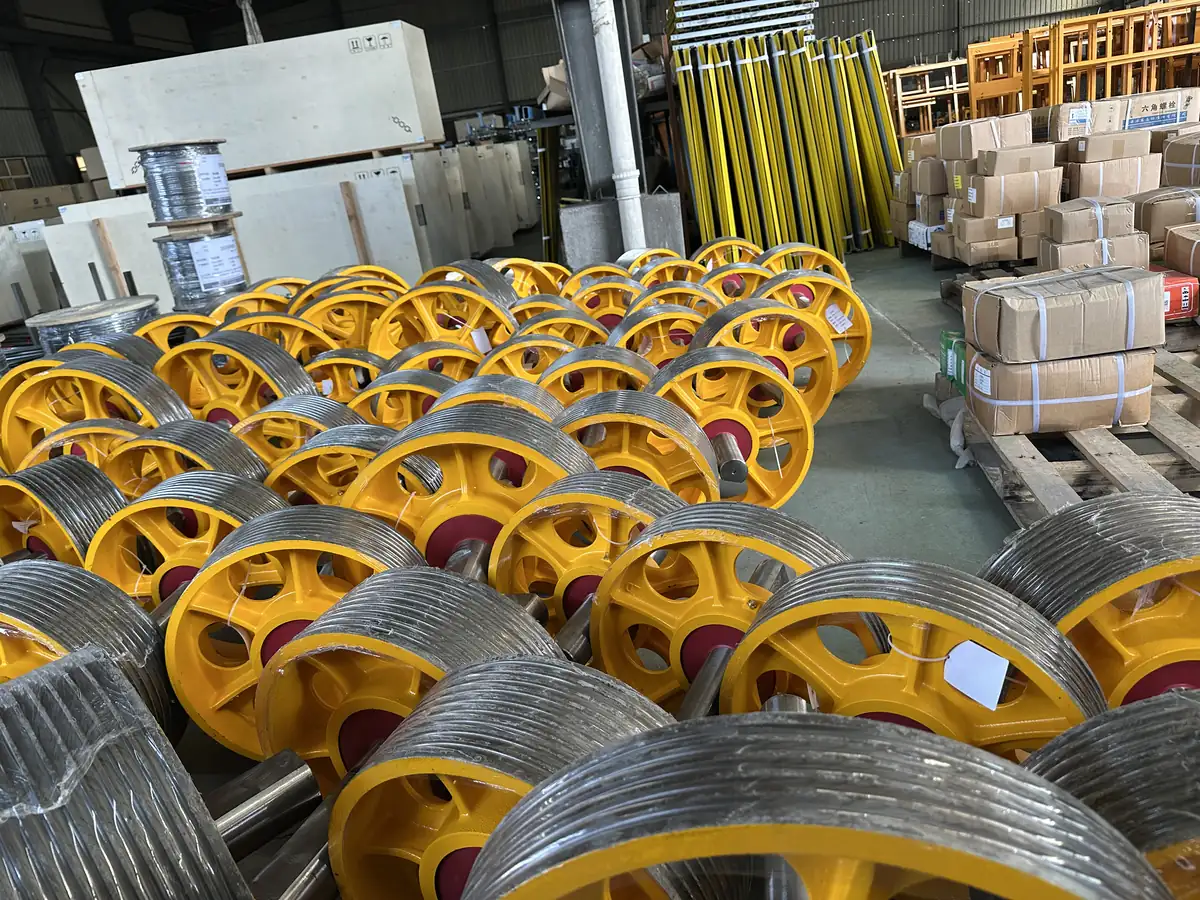
Elevator spare parts held at the BST Express Elevator works in Suzhou: sheaves and rope coils are stocked because they are the parts an importer cannot buy locally at short notice.
The Warranty Boundary: Three Buckets Every Contract Needs
A single line saying “two years warranty” tells a buyer almost nothing. What decides the cost of ownership is a split into three buckets, because the three behave very differently when something fails at month fourteen.
| Bucket | What sits in it | What the contract must state |
|---|---|---|
| Unit assembly | Car, sling, doors, wiring harnesses, assembly quality | Start date, length, and that it covers workmanship as well as parts |
| Bought-in components | Traction machine, controller, door operator, inverter | Make and model of each item, its own warranty length, and who the buyer contacts |
| Wear parts | Door rollers, lock contacts, buttons, guide shoe liners, ropes | An exclusion list by part name, not by category, plus the spare kit that offsets it |
The third bucket is where most disputes start. “Consumables excluded” is too vague to argue about on site, so name the parts one by one and agree which of them travel with the machine. A wear part named in the exclusion list and also named in the elevator spare parts kit is the only version of that clause that protects anybody.
Then fix the start date, because four different anchors are in common use: the factory dispatch date, the bill of lading date, the arrival date at site, and the handover date. Between dispatch and handover a unit can sit in a container, in a customs yard and on a site waiting for civil works to finish.
The exclusion list and the elevator spare parts kit are two halves of the same agreement, so negotiate them together rather than in two annexes nobody reads side by side.
Only the handover date protects the buyer, and it is the single line worth arguing over. Ask for coverage to run from handover and to include the commissioning period, which is when most faults actually appear.
One more boundary matters on mixed projects: when a contract covers several units, the warranty clock starts separately for each one. A second car commissioned six months after the first should not be sharing a start date with it, or the buyer loses six months on the later unit without noticing.
The Wear Parts List: What Fails First
Most breakdowns in the first three years are not component failures, they are wear. The parts below generate the bulk of service calls, and none of them is expensive. The cost is the downtime and the air freight on a part that weighs less than the paperwork.
| Wear part | How it shows up | What to inspect | Carry as spare |
|---|---|---|---|
| Door rollers and hangers | Door drags, runs unevenly, jumps at the sill | Roller wear, door plumb, track condition | One set per unit |
| Door lock contacts | Car will not start with the doors closed, intermittent stop | Contact pitting, gap, wiring at the lock | One set per unit |
| Push buttons and COP | Button does not return, lamp dead, call not registered | Button travel, terminal tightness | Two to four per unit |
| Guide shoes or roller guides | Shudder, shaft noise, uneven ride quality | Liner clearance, flat spots on rollers | One set per unit |
| Suspension ropes | Broken wires, reduced diameter, corrosion | Rope surface, end fixings, tension balance | On demand, not stocked |
| Levelling and door zone switches | Stops off level, re-levelling loops | Switch actuation, bracket tightness | One or two per unit |
| Contactors and relays | Chatter, burnt contacts, single-phasing symptoms | Contact pitting, coil condition | One set per unit |
| Inverter cooling fan | Overheat trip after long runs | Fan rotation, dust build-up on the heatsink | One per unit |
Notice what the table does not contain: replacement intervals in years. Rope life depends on sheave condition, load and trips per day. A rope that fails an inspection at year four is no better than one that fails at year two, and a calendar-based elevator spare parts order guesses at both.
A practical elevator spare parts plan is built from the inspection schedule rather than from a supplier catalogue, because the two lists rarely agree on what matters.
Judge wear against inspection criteria instead. Write the criteria into the maintenance schedule, and the spare order follows from the inspection rather than from a habit.
Door parts deserve the closest attention because they fail most often relative to their cost, and because a door fault stops the car. A door that closes on a slow cycle, reopens without a call or stops short of the sill is telling you the roller and the track are worn, weeks before the lock circuit refuses to make.
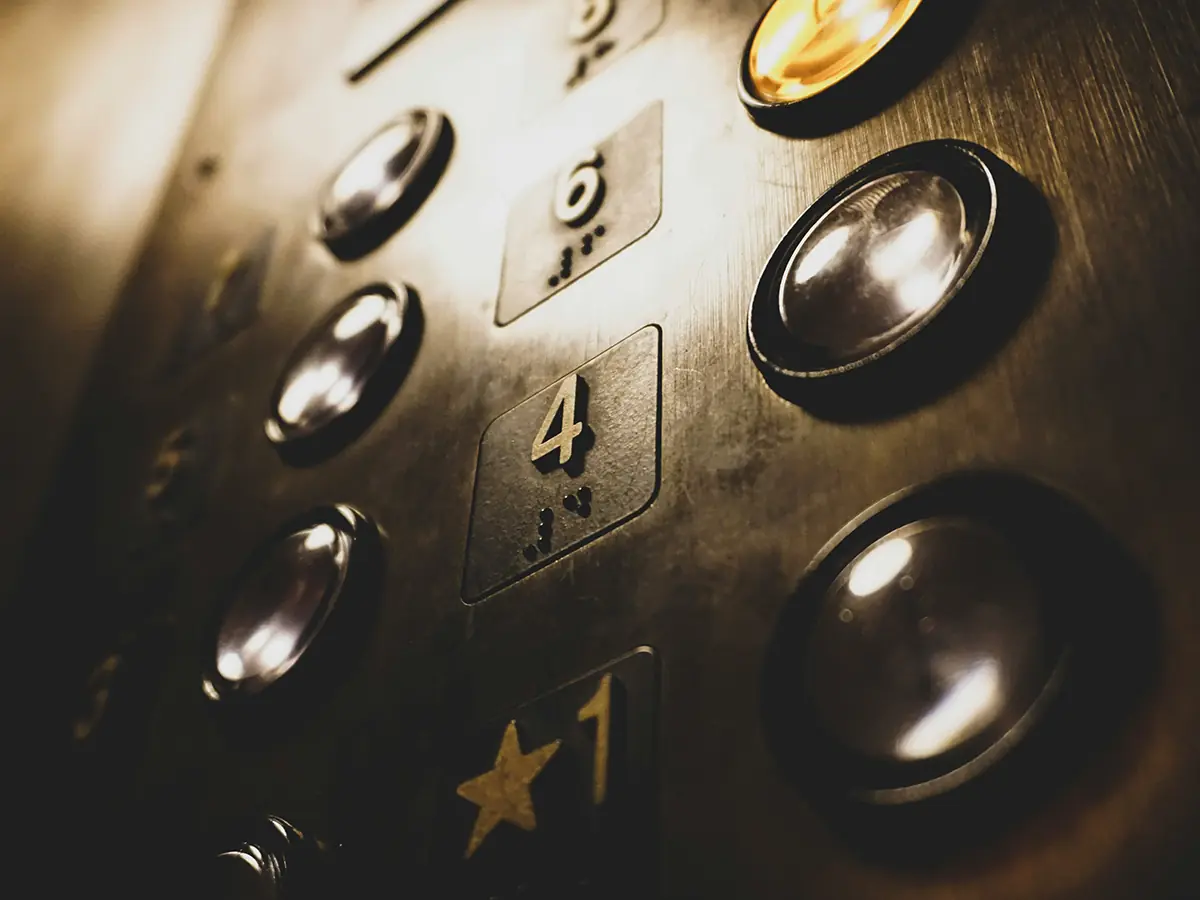
Push buttons and car panels are among the first elevator spare parts an importer runs out of, because a single unresponsive button takes a whole car out of service.
How Many Elevator Spare Parts Ship With the Unit
Commissioning spares are the parts an installer needs in the first weeks, and they belong in the original container. Ordering them later means air freight, customs clearance and a week of downtime for a part that costs less than the freight.
A workable kit for a standard passenger or freight unit contains:
- Door rollers and door lock contacts, one set per unit
- Push buttons, two to four, matched to the car panel design
- Guide shoe liners, one set per unit
- Fuses, control circuit breakers and indicator lamps, one of each rating used
- Door zone and levelling switches, one per unit
- A printed parameter list and the fault code table
The size of the kit is a commercial question, not a technical one. Ask for the elevator spare parts list to be quoted at three levels: commissioning only, commissioning plus one year of wear, and commissioning plus two years, and the price gap between them tells you what the factory expects to fail.
Two practical details decide whether that kit is useful on site. First, pack it as its own case with a numbered packing list rather than loose inside the machine crate, because a box that takes an hour to find is a box that gets lost. Second, label every part with the unit serial number it belongs to, since a project with four elevators will mix them the first time a technician dips into the case.
Write the elevator spare parts in the kit into the contract by name and quantity. A short shipment then becomes a documented claim instead of an argument about what “a basic spares package” was supposed to mean.
What does not belong in the first container
Ropes, the traction machine and the controller are not commissioning spares. They are heavy, they are covered by the component warranty, and stocking one of each would add weight to a container for a part that fails once in a decade. Buy those on demand, against a price that was locked in the annex.
The same applies to cosmetic items. A spare car panel, a spare landing door and a spare handrail look like prudent planning on paper and become dead stock in a store room. The dividing line is simple: if a failure stops the car and the part costs little, stock it; if a failure is rare and the part is heavy, price-lock it instead.
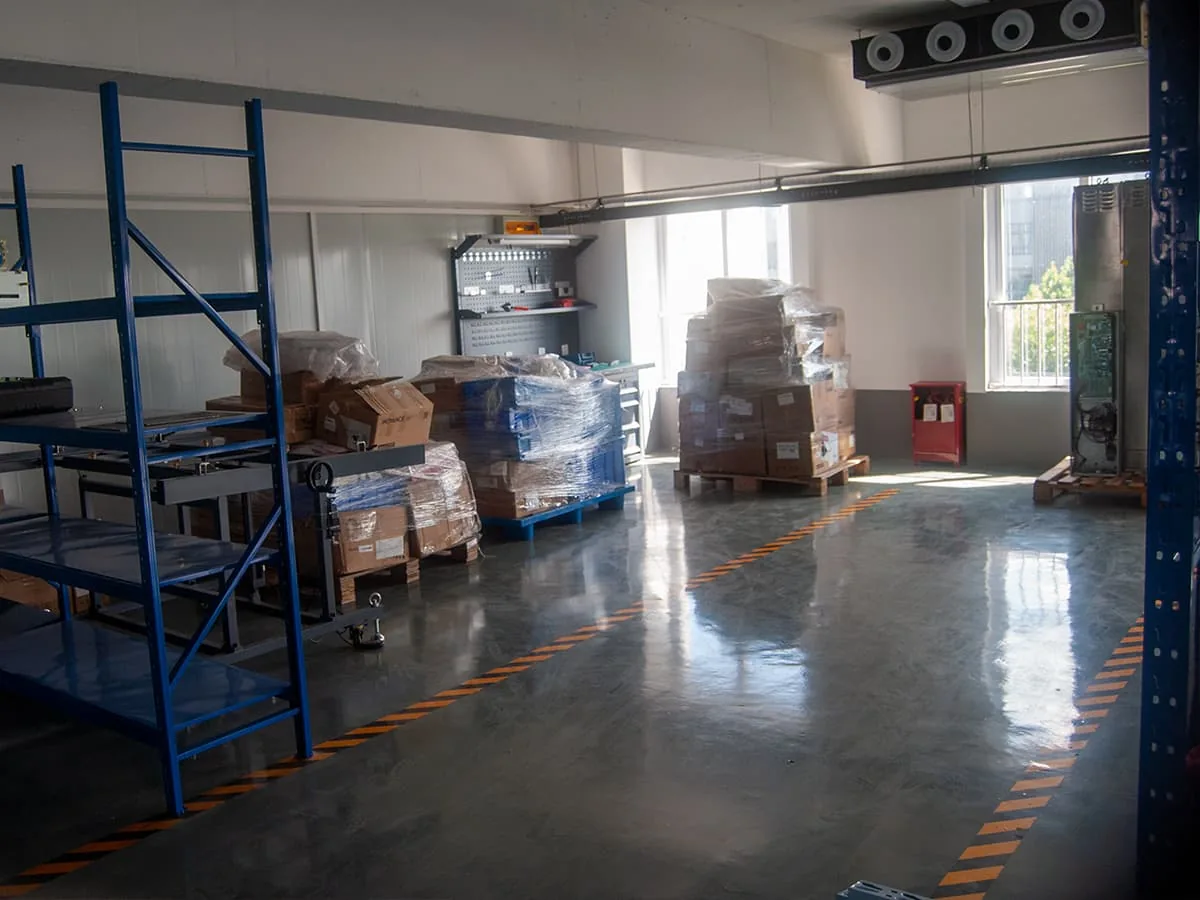
Cartons staged for container loading at the BST Express Elevator works: the commissioning kit travels with the machine, not in a later shipment. Loading practice is set out in this guide to elevator shipping and container loading.
Price Locks, Obsolescence and the Technical File
Three commercial terms decide what elevator spare parts cost in year three, and none of them appears on a standard price list.
Price lock
Attach a priced elevator spare parts annex to the contract and lock it for a stated period. Twelve months is a realistic ask and an easy one for a factory to grant, because it only fixes a list that already exists. Without it, the same door roller can double between the equipment order and the first reorder.
Get the annex quoted against the model and specification you are actually buying, not a generic list. An elevator spare parts schedule that quotes a 630 kg door operator for a 1600 kg freight unit is worse than no schedule, because it looks agreed.
Obsolescence
Controllers, inverters and door operators are revised every few years. Ask what happens when the model in your unit is discontinued: an equivalent replacement, an upgrade path with the wiring changes documented, or a last-time-buy option. A written answer here is worth more than a longer warranty.
The technical file
The team that takes over maintenance after handover needs four documents: the as-built GA drawing, the wiring diagram, the fault code table and a backup of the inverter parameters. Without the last two, a third-party technician cannot diagnose anything and every call becomes a factory call.
These files cost nothing to send at handover and are close to impossible to reconstruct three years later, which is why they belong on the delivery checklist next to the certificate package. A quotation that lists them explicitly, in the form set out in this elevator quotation checklist, is the one to compare against.
The Claim Process in Five Steps
A warranty is only as good as the process behind it. Most disputes are not about whether a part failed, they are about who proves it and who pays the freight.
| Step | Buyer sends | Factory returns | Target clock |
|---|---|---|---|
| 1. Stop and isolate | Photos of the stopped car, the fault code, the unit serial number | A holding instruction and a safety check | First response within 24 hours |
| 2. Evidence | Close-ups, a short video, a photo of the nameplate, trip count if available | A preliminary call: in warranty or not | Within 48 hours |
| 3. Assessment | Access for a third-party inspection if the call is disputed | A written finding with the reason | Before any part is ordered |
| 4. Remedy | Shipping address and customs broker details | Replacement part, credit note, or a local repair authorisation | Dispatch decision within five working days |
| 5. Close out | Confirmation of fitment and the condition of the replaced part | Failure record logged against the batch | On receipt |
What counts as proof is usually defined earlier in the project: the load test and inspection records accepted at pre-shipment are the baseline against which a warranty claim is measured, as set out in this guide to the elevator load test.
None of these steps works without the failed part. Keep it, label it with the unit serial and the removal date, and do not let it leave site until the claim is agreed, because an elevator spare parts claim with no failed part is a conversation rather than a case.
The clocks above are targets, and they only bind if the contract says so. Put a first-response time and a dispatch window in writing, and name the mailbox that receives claims so a message to a personal account is not the only route.
There is a legal reason to move fast as well. Under the UN Convention on Contracts for the International Sale of Goods, a buyer must examine the goods within as short a period as is practicable and give notice of a lack of conformity within a reasonable time, or lose the right to rely on it. The full text is published by UNCITRAL.
In practice that means the open-case inspection window in your contract is the clock that matters, not the warranty headline. A fault photographed on arrival and reported the same week is a straightforward claim; the same fault reported after the unit has been installed is a negotiation.
Record the arrival inspection properly and it pays for itself twice. Photograph the crate before opening, the packing list as found, the contents as unpacked, and any transit damage before it is moved. Those images are also the baseline for the installation handover, which is where the next dispute usually starts.
What Voids an Elevator Warranty
Exclusions are written into every warranty and most of them are fair. The problem is that buyers read them after a failure rather than before an order.
- Unauthorised modification: extra counterweight, a wider door opening, or a changed control logic without written approval
- Abnormal supply: phase loss, voltage outside the rated band, or a generator switched without a changeover delay
- Water ingress: a pit without drainage, or a shaft that takes rain before the roof is closed
- Overload use: a freight unit driven like a forklift, or a passenger unit used for building material
- No maintenance record: a warranty that requires periodic servicing is void without evidence of it
- Third-party safety components: ropes, locks or speed governors from an unapproved source
- Unauthorised shaft modification after the survey was signed
Two of these deserve a note. Voltage problems are the most common avoidable exclusion, because an imported unit expects a stable three-phase supply and an unstable grid or a badly switched generator will log overvoltage and phase-failure faults until the controller gives up. Fixing the supply is always cheaper than fixing the controller, and the checks are set out in this guide to elevator power supply.
A third is worth watching. Non-approved elevator spare parts fitted during a repair can void the warranty on the assembly they touch, even when the failed part itself was covered, so keep a record of every part number that goes into the machine.
The second is maintenance evidence. Keep a signed log from the first month, not from the first failure, and keep it in a form you can send as a PDF when a claim is questioned.
For the replacement work itself, isolate and lock off before any part is changed. Lockout procedures are a legal requirement in many markets and a basic safety step everywhere; the practice is documented by bodies such as the US Occupational Safety and Health Administration, and by the UK Health and Safety Executive in its guidance on lifting equipment.
Water ingress is worth a line of its own because it is nearly always a civil works failure, not an equipment failure, and it is still nearly always argued as a warranty claim. A pit that holds water after a rainy season will destroy door operators and safety switches from below, and no supplier will accept that as a defect in supply.
Four Clauses Buyers Most Often Miss
1. The elevator spare parts price lock
Covered above, and still the most commonly missing page in an export contract. Ask for the annex even when the equipment price is already agreed, because it costs the factory nothing to issue and saves the buyer a renegotiation later.
One clause deserves its own paragraph. If the annex lists elevator spare parts by description instead of part number, the price lock is unenforceable from the first order, because the supplier can always argue that the part you want is a different item from the part that was priced.
2. Discontinued part replacement
The clause should say what happens, not that the factory will “try to help”. An equivalent part with documented wiring changes, or a last-time-buy at contract prices, are both acceptable answers. Silence is not.
3. Technical file delivery at handover
List the four documents by name in the delivery schedule, and tie the release of the last documents to the same milestone as final payment. Documents promised verbally have a habit of arriving after the retention payment.
4. Response time and escalation path
A first-response window, a named contact and an escalation route to a manager turn a warranty from a promise into a process. Without them, a stopped car waits on whoever checks their phone first.
When the Installer Is Not the Manufacturer
On most export projects three parties touch the equipment: the factory, the installation team and the owner. Warranty arguments begin when nobody can say which of the three caused the fault, and the answer is almost always in records that nobody kept.
The boundary usually runs like this: the factory is responsible for the equipment and its components, the installer for installation quality such as plumb, door gaps and terminations, and the owner for supply, civil works and pit drainage. Write that split into the contract as a table, with the interface points named.
Two habits keep the boundary clean. Keep the open-case photo set from arrival, and keep an installation record with the date each unit was powered, levelled and handed over. When a door drags at month eight, those two files decide whether a roller failed early or a door was hung out of plumb.
Buyers still comparing suppliers will find the contract sequence in this six-step guide to buying elevators from China useful, because the warranty and spares annex belong to step four, alongside the drawings and payment terms, not to the final paperwork.
Decide early who holds the elevator spare parts account as well. An owner who buys through the installer pays a margin and waits for a consolidated order; an owner with a direct account orders a door roller on Monday and fits it on Friday.
Site readiness is the other half of that split, and it is worth checking against the requirements in this guide to elevator installation requirements before the crew is booked. A shaft that is out of plumb produces door faults that look like worn parts for the first year.
Warranty or Maintenance Contract: What Each One Covers
A warranty and a maintenance contract are two different documents, and buyers routinely assume the first includes the second. It does not.
A warranty covers defects that were present at the time of supply: a controller that fails at month four, a door lock that never worked properly, a rope that shows broken wires early. A maintenance contract covers the work that keeps the unit running: cleaning, lubrication, adjustment, periodic inspection, and the replacement of wear parts as they reach their limits.
The gap between the two is where imported units suffer most. A project can hold a perfectly good two-year warranty and still have a car standing for a week, because nobody contracted for the adjustment work that would have caught the door roller in month nine.
Three questions settle the split before you sign. Who inspects, and how often? Who supplies the elevator spare parts used during servicing, and at what price? And who is allowed to sign off that a unit is back in service after a repair?
A maintenance scope also fixes the elevator spare parts budget, because a service visit that includes a defined set of wear items can be priced per unit per year. Without that definition every visit is a new quotation and every part is an argument.
Answering them in writing changes what you buy. A maintenance scope that names the inspection items, the elevator spare parts included in a service visit and the reporting format is a service contract. The same paragraph without those details is an agreement to send someone when called.
It also changes the annual budget. Servicing consumes wear parts on a predictable cycle, so the elevator spare parts cost of a maintenance contract can be estimated from the inspections rather than discovered from invoices. Projects that skip this step usually find that year three costs more than year one and two combined.
For an imported unit the practical answer is a two-part arrangement: the factory covers defects under warranty, and a local contractor covers routine work under a service scope defined by the factory’s maintenance manual. Where a local contractor cannot be contracted, the same elevator spare parts kit described above becomes the maintenance plan, with the owner’s technician following the manual instead.
How BST Express Elevator Structures Warranty and Spares
BST Express Elevator quotes elevator spare parts as a priced annex rather than a paragraph, so the list, the quantities and the price lock can be checked line by line before the contract is signed. The annex covers the wear parts described on this page plus the major bought-in components, each on its own line.
Three documents are issued with every elevator spare parts quotation from BST Express Elevator: the wear-part kit list sized to the landing count, the component warranty schedule with make and model for each item, and the technical file index that ships with the unit. Keeping them separate means a buyer can compare two suppliers on the parts that actually wear.
A buyer comparing offers should treat the warranty and the elevator spare parts annex as one package, since a long warranty with an unpriced parts list is worth less than a shorter warranty with a locked list.
For projects where the installer is a local contractor, the factory can also quote a two-year recommended spares set alongside the commissioning kit, so parts that wear by year three are bought at the same price as the machine rather than at air-freight prices later.
The reason to keep the three documents separate is practical: a buyer can compare two suppliers on the parts that wear, the components that carry their own warranty, and the files that a local maintenance team will need, without reading two hundred pages of specification to find each line.
Warranty dates are counted from handover on BST Express Elevator projects, not from the dispatch date, and each unit carries its own start date when a contract covers several cars. Buyers comparing offers across suppliers should check that line first, because two identical warranty lengths can be months apart in coverage.
Frequently Asked Questions
How long is an elevator warranty?
Component warranties commonly run twelve to twenty-four months, but the length matters less than the start date. A two-year warranty counted from the factory dispatch date can expire before the unit is handed over, so ask for coverage to run from handover and to include the commissioning period.
Are elevator spare parts included in the price?
A commissioning kit is normally included and should be listed by name and quantity. Everything beyond that kit is a separate order, so ask for a priced elevator spare parts annex with a price lock rather than assuming a basic package covers what will actually wear.
Which elevator spare parts should I order with the first container?
Door rollers and lock contacts, push buttons, guide shoe liners, fuses and control circuit breakers, one door zone or levelling switch per unit, plus the printed parameter list and fault code table. Ropes and other heavy parts are better bought on demand than stocked.
Who pays the freight on a warranty part?
This is worth settling in writing. Many contracts cover the part but not the freight, which on an air shipment can exceed the value of the part. Ask for air freight to be covered on in-warranty failures during the first twelve months, when a failure is most likely to be a defect rather than wear.
Can I buy elevator spare parts from a third party?
For wear parts, yes, provided the specification matches. For safety components such as ropes, locks and speed governors, an unapproved source is a common warranty exclusion and may also fail a periodic inspection, so keep those on the original supply route.
Does the warranty cover the installation?
Usually not. The factory covers the equipment and the installer covers the installation, which is why the split needs to be written down with the interface points named. If one company supplies and installs, ask for that scope to be stated together in the warranty.
[…] for a 60 Hz grid. The lift may run, but the fan cools less, the metering reads wrong and the warranty argument […]