


An elevator load test is a series of runs with weighed loads on the car. It proves four things — the
brake stops a loaded car, the traction holds, the overload device trips, and the structure does not
deform — before shipment and again at handover. A report without measured numbers proves nothing.
What this page covers
- What an elevator load test actually proves
- The seven checks inside the sequence
- What the load figures have to be
- How it runs on the factory floor
- What a report must contain
- Who should witness the test
- How to spot a recycled report
- What the handover test adds
- What changes after the test
- Frequently asked questions
What an Elevator Load Test Actually Proves
The question an elevator load test answers is not whether the lift moves. A car that moves under
load can still be unsafe in four separate ways, and each one needs a different weight on the floor.
- The brake holds a loaded car. A brake sized on an empty car slips when the car is
full. The test cuts power with the test load on board and measures how far the car travels before it stops. - Traction is sufficient. The sheave must grip the ropes without slip when the car is
loaded and the counterweight is near the top. Rope slip under load is the failure that no later
adjustment fixes. - The overload device trips. The device has to detect the overload, sound an alarm,
hold the doors open and refuse to start — all before the car is asked to move. - The structure takes the load. A static hold at the test load shows whether the car
frame, platform and suspension deform permanently.
BST Express Elevator runs this full sequence on every unit at its Suzhou test tower
before packing, and the recorded result travels with the container documents. Buyers who have watched
one elevator load test run rarely ask for a second opinion on the machine.
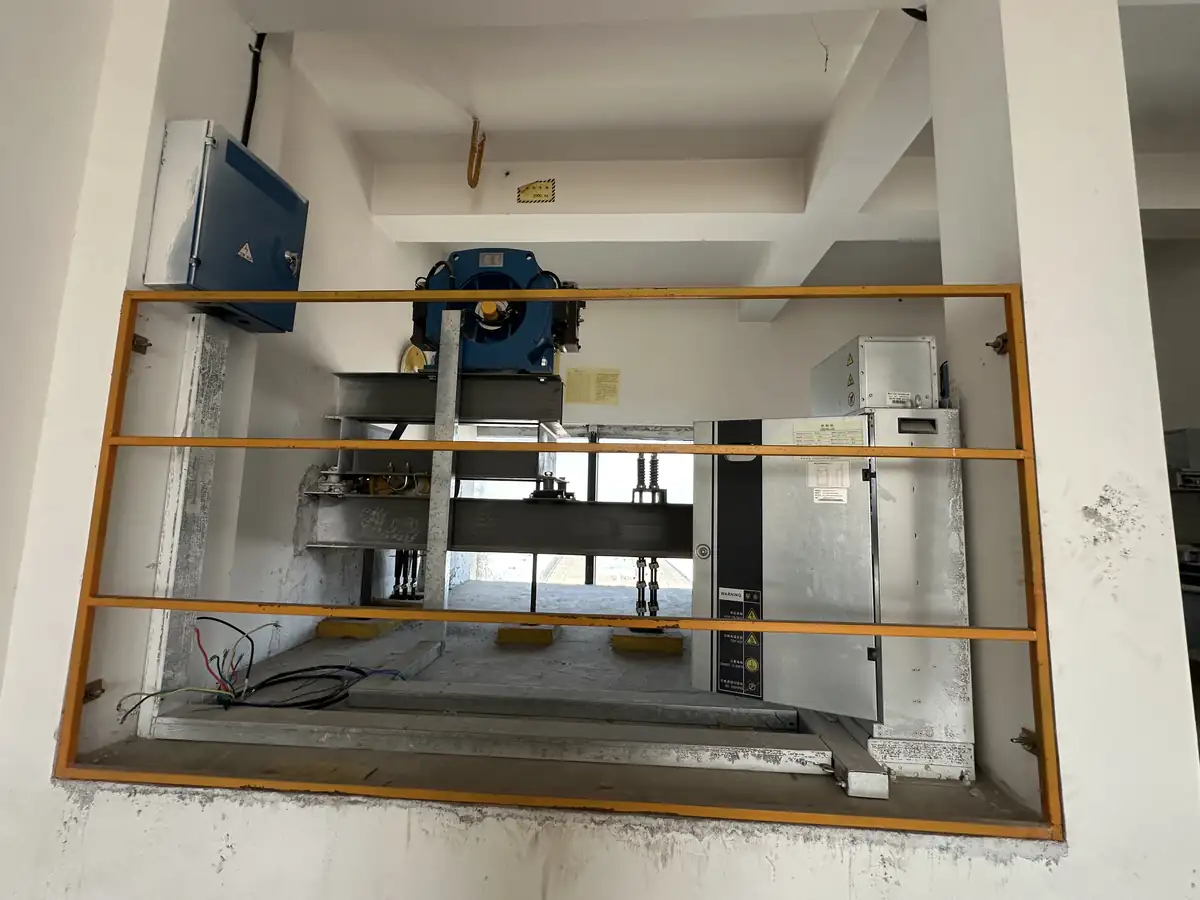
The Seven Checks Inside an Elevator Load Test
Seven checks make up an elevator load test rather than one. The order matters: the balance
coefficient decides whether the later runs mean anything, so it is measured first and every reading
after it leans on that value.
| # | Check | Load on the car | What it proves |
|---|---|---|---|
| 1 | Empty-car run | 0% | The brake releases cleanly, the car levels at every landing and the ride is free of vibration. |
| 2 | Balance coefficient | 30%, 40%, 45%, 50%, 60% | The counterweight is set correctly. Motor current is read up and down at each step, and the two curves cross inside 0.40–0.50. |
| 3 | Rated-load run | 100% | The machine pulls the rated load at the rated speed, and levelling still holds at every landing. |
| 4 | Overload device | 110% | The device detects the overload, signals it, holds the doors open and blocks the start. |
| 5 | Brake test | 125% | The brake stops the loaded car inside the permitted distance, with no rope slip. |
| 6 | Static hold | 125%, held 10 minutes | Car frame, platform and suspension carry the load with no permanent deformation. |
| 7 | Safety gear trip | At trip speed | The governor fires, the safety gear grips the rails and the car stops. |
Checks five to seven are the ones buyers should ask to see on video. They are also the
three that a factory cutting corners quietly skips, because each needs weights standing on the car for
an hour or more, and weights are the slowest part of an elevator load test.
What the Load Figures Have to Be
The load applied in an elevator load test is not a matter of preference. The figures below come from the
Chinese inspection code, which is the code most export factories are actually audited against, plus
the two European standards that govern a CE-marked unit.
| Figure | Requirement | Where it comes from |
|---|---|---|
| Rated load | Nameplate value — 630 kg to 10,000 kg on freight models | Unit specification |
| Balance coefficient | 0.40 to 0.50, measured from the current curves | TSG T7001-2023 (China) |
| Overload detection | No later than 110% of rated load | TSG T7001-2023 (China) |
| Brake test load | 125% of rated load | TSG T7001-2023 (China) |
| Static hold time | 10 minutes at the test load | TSG T7001-2023 (China) |
| Static and dynamic tests | Both required, separate from the run checks | EN 81-20 and EN 81-50 (EU) |
| Acceptance run at handover | Loaded run before the unit is handed over | ASME A17.1 (US) |
Two things follow from that table. First, a car rated 2,000 kg is tested at 2,500 kg, so
the structure is designed around the test load rather than the nameplate. Second, the European standards
require both a static and a dynamic test but leave the acceptance sequence to the national inspector,
which is why a unit bound for the EU carries two sets of paperwork for one elevator load test.
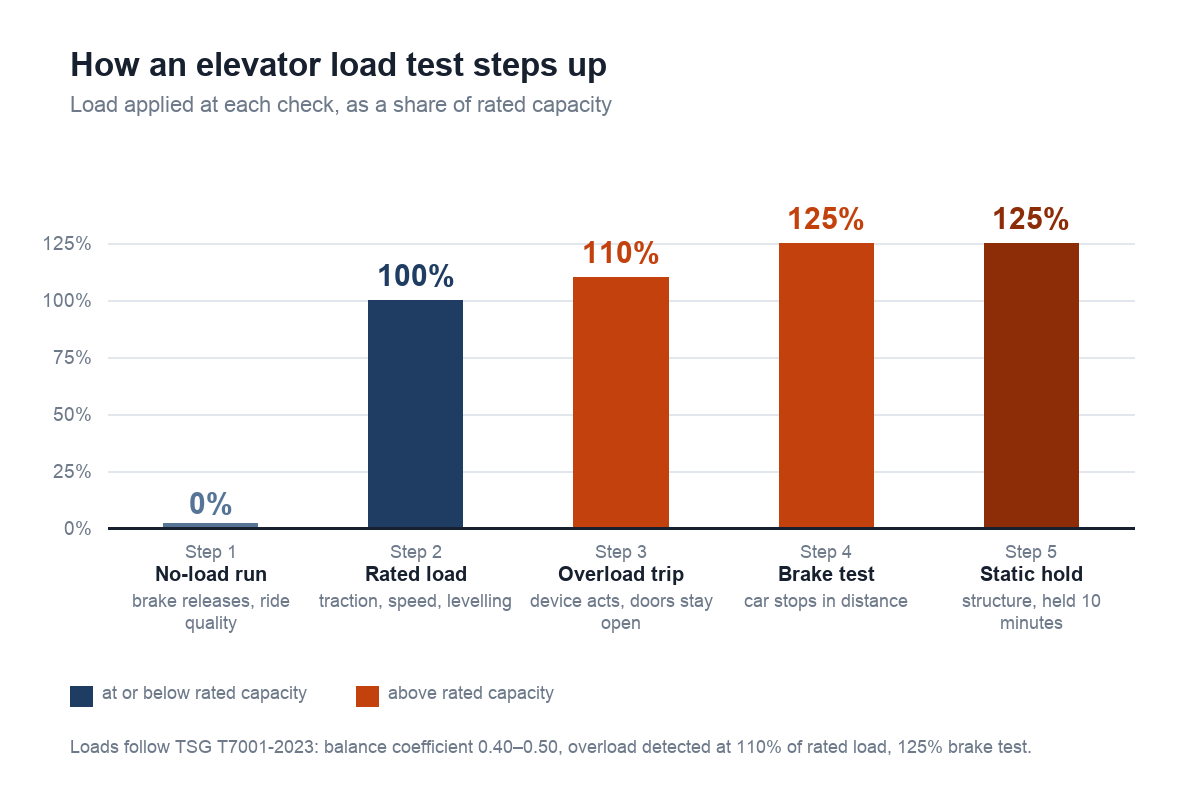
The 110% line is the one to remember at handover. A car that starts to move with 110% on
board, even slowly, has a device that needs recalibrating before the building takes delivery. That
recalibration is an adjustment at the factory and a return visit on site, which is the whole reason the
number is checked before packing.
How an Elevator Load Test Runs on the Factory Floor
An elevator load test at the factory takes half a day to a full day per unit, and most of that time goes on
handling weights rather than measuring. The sequence is the same for a 630 kg passenger car and a
5,000 kg freight car; only the weights scale.
- Weigh and stack the load. Cast iron weights or water bags are counted against the
rating, never estimated from the car size. - Measure the balance coefficient. The car is loaded in steps and current is read in
each direction at the same height; the crossing point of the two curves is the coefficient. - Run the loaded car at every landing. Speed, acceleration and levelling are recorded
at each stop and compared with the drawing. - Cut the power under load. Brake distance is measured and written down, not marked
as passed. - Trip the overload device. Load is added until the device acts, and the trip point
is recorded in kilograms and as a percentage. - Hold the static load. The loaded car stands for ten minutes, then the frame is
checked for permanent set. - Record and release. The serial plate goes into the same frame as each reading, and
the unit is released to packing.
This is the step that decides the shipment date. A failed elevator load test means a counterweight
change or a brake adjustment, and both add days — which is why elevator
lead time is measured from a passed test rather than from the order date.
What an Elevator Load Test Report Must Contain
An elevator load test report is only useful if someone who was not there can check it. Nine items make
that possible:
- The unit serial number and the drawing revision that was tested.
- The date, the ambient temperature and the name of the tester.
- Each check with the load actually applied, in kilograms and as a percentage.
- The measured result for each check, not a pass mark.
- The balance coefficient value and the current readings behind it.
- The brake stopping distance and the speed it was measured at.
- The overload trip point in kilograms.
- The calibration number of every instrument used.
- A photograph or video reference for each check, with the serial plate visible.
Three of those nine go missing most often. The current readings behind the balance
coefficient and the brake stopping distance disappear first, and both are the numbers an inspector
recomputes before anything else.
Who Should Witness the Test
Four parties can stand next to the car during an elevator load test, and they do not carry the same
weight.
| Witness | What it covers | What it does not |
|---|---|---|
| Factory QC | Every unit, every check | Independent verification |
| Third-party inspector | The checks you name in the booking | Anything left out of the scope |
| Notified Body | Component type examination | Individual units |
| Destination inspector | Local acceptance at handover | The factory test |
The cheapest arrangement for a first order is a third-party inspector booked for the
elevator load test alone, with the checklist agreed in advance. A Notified Body certificate does not replace that: it
is issued against a component type rather than the car in your container, which is why the
EC-type examination file and the unit test report
answer different questions.
How to Spot a Recycled Elevator Load Test Report
Most poor elevator load test reports are not forged. They are real reports for a different unit, or real
reports with the measurements left blank. Six signals separate the two kinds.
- Every line says PASS and no line carries a number.
- The serial number is a model family — a series name instead of one unit.
- The balance coefficient is a round number such as 0.50, where a measured value
looks like 0.47. - The photograph shows a car you did not order — wrong door type, wrong cabin size,
wrong finish. - The dates do not fit — tested after packing, or tested before the car was
assembled. - Only a PDF exists, with no original photographs and no instrument numbers.
Any one of those is worth a question. Two together mean the report should be reissued
before the balance is paid, and a supplier who resists reissuing it has told you what the elevator load test was
worth.
What the Handover Test Adds
The factory run and the handover run are not the same test twice. At handover the guide
rails are new, the pit depth is whatever the builder delivered, and the door alignment has just been set
by an installation team.
An elevator load test at that stage catches what the factory could not: a rail bracket
that flexes under load, a sill that catches the door when the car settles, a pit that came in 80 mm
shallow. None of those variables exist in a factory shaft.
Three figures in the handover elevator load test are re-measured on site. Levelling is
checked at every landing with the rated load on board, the brake distance is repeated, and the overload
device is confirmed to trip before the building opens. On a freight unit the loaded run also confirms
the floor loading the slab was designed for, which is the figure most often argued about after
handover.
BST Express Elevator ships the factory elevator load test report in the container
documents and asks the installation partner to return the handover sheet against it, so the two records
sit side by side.
What Changes After the Test
A passed elevator load test rarely leaves the unit untouched. Three adjustments come out of it more
often than any other: the counterweight is re-cast to bring the coefficient into range, the brake gap is
reset after the 125% stop, and the overload switch is recalibrated to trip inside the 110% window.
All three are cheap at the factory and expensive on site. That is the whole argument
for testing before packing rather than at handover, and the reason the
six-step buying process puts the test before the
container booking rather than after arrival.
A freight unit runs the same sequence with the load class fixed on the
freight elevator specification, because a car built for pallet
traffic is tested at a different floor loading than one built for passengers. Buyers who need the
result filed for Europe should read what a CE certification
package contains before booking the inspection. Send the unit rating and
the destination and BST Express Elevator returns the test plan with the weights and checkpoints
marked on it.
Frequently Asked Questions
How long does an elevator load test take?
Around four to eight hours per unit at the factory. Moving 2,500 kg of weights in and out of a 2,000 kg car takes longer than the measuring itself, and a 5,000 kg freight unit needs a full day.
Is the elevator load test done at the factory or on site?
Both, for different reasons. The factory run decides whether the unit ships. The handover run proves the installation, where the guide rails, the pit and the door alignment are new variables.
What load is used for an elevator load test?
Three loads matter: rated load for the run checks, 110% for the overload device, and 125% for the brake and static tests. A unit rated 1,600 kg is loaded to 2,000 kg at the brake test.
Can I skip the elevator load test to save time?
Not on any market that inspects lifts. The handover inspection will ask for the record, and a unit that fails on site costs more to correct than the week it saved.
What is a good balance coefficient?
Between 0.40 and 0.50, as a measured value rather than a round number. Below 0.40 the machine works harder on a loaded car; above 0.50 the empty car loses traction.
References
- China Special Equipment Inspection Association — guide to lift inspection and periodic testing (balance coefficient, overload device and brake test figures).
- European Commission — lifts and the Lifts Directive.
- State Administration for Market Regulation — special equipment safety bureau (issuing authority for TSG regulations).
[…] overload line is the one item a buyer cannot verify from a photograph. How the 110% overload and 125% brake tests are actually run walks through the sequence, the witness points and the numbers that have to appear on the […]
[…] What counts as proof is usually defined earlier in the project: the load test and inspection records accepted at pre-shipment are the baseline against which a warranty claim is measured, as set out in this guide to the elevator load test. […]
[…] What counts as proof is usually defined earlier in the project: the load test and inspection records accepted at pre-shipment are the baseline against which a warranty claim is measured, as set out in this guide to the elevator load test. […]
[…] become the only evidence that the lift was installed as designed. That record is set out in the load test guide, and it should be agreed before work starts rather than argued over at the […]
[…] test evidence. A load test report naming your model, the test loads and the date, plus photographs of the unit under […]