

No escalator type examination exists in EU law, and the Lifts Directive cannot provide one: Article 1(2)(k) of Directive 2014/33/EU excludes escalators and mechanical walkways from its scope. Escalators fall under the Machinery Directive, do not appear in Annex IV, and reach the CE mark through internal production control.
The certificate route is only half the file; the six site checks that fix truss span and support reactions sit on the installation drawing.
What this page covers
- What an escalator type examination would even be
- The term comes from a directive that no longer exists
- Escalators are written out of the Lifts Directive
- Not in Annex IV of the Machinery Directive either
- The conformity route an escalator actually takes
- What EN 115-1:2017 gives the manufacturer
- When a notified body is genuinely involved
- What a voluntary third-party certificate proves
- From 20 January 2027 the rules become a regulation
- What to ask a supplier before you sign
- How BST Express Elevator documents the route
- Frequently asked questions
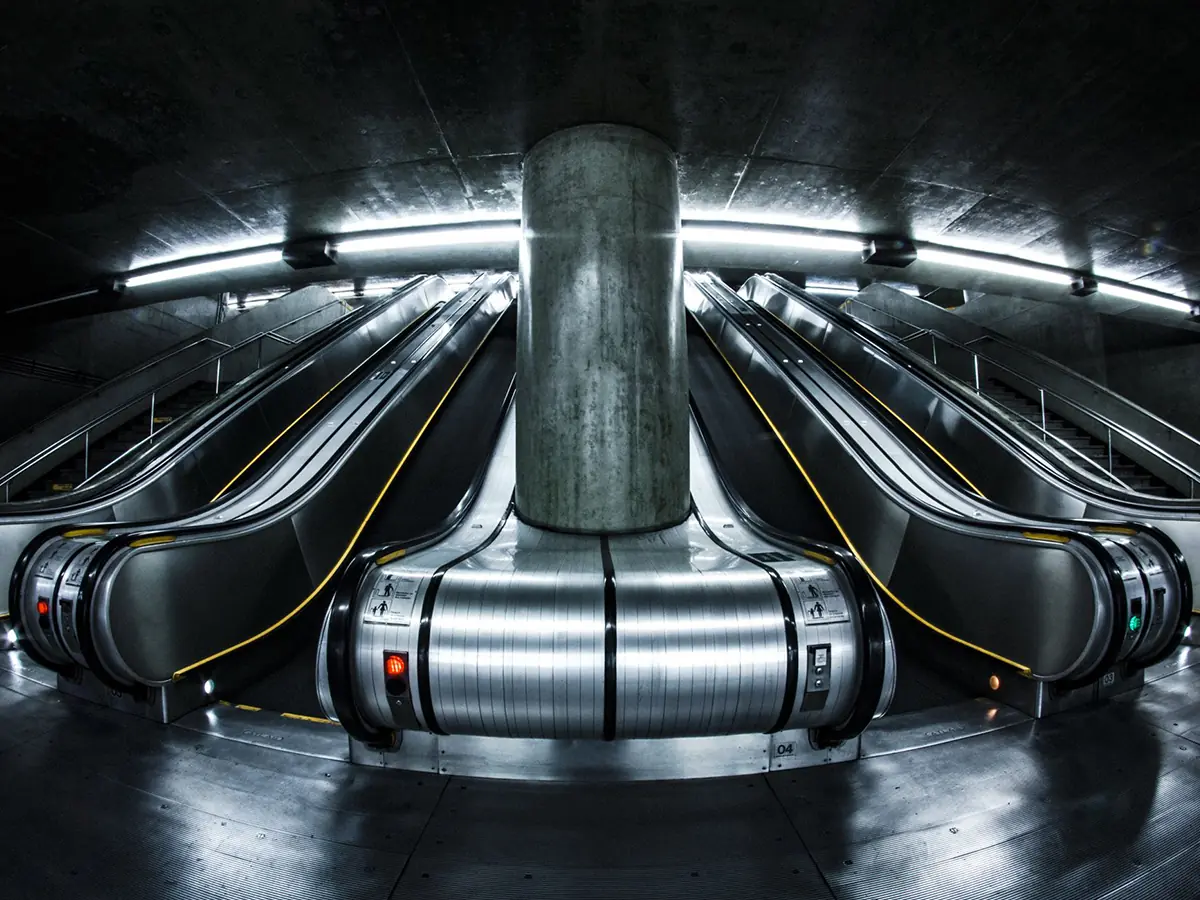
Three escalators at a metro interchange. A machine like this leaves the factory with a CE mark and an EU declaration of conformity signed by the manufacturer, not with a type-examination certificate, because EU law does not issue one for this product category.
What an Escalator Type Examination Would Even Be
The escalator type examination phrase hides three different procedures that share almost the same name. Buyers use one word for all three, suppliers answer with whichever certificate they happen to hold, and the conversation drifts away from the only question that matters: which procedure does EU law actually apply to this machine. For an escalator, the answer to an escalator type examination request is that no such procedure exists in either directive.
An escalator type examination request therefore arrives with a false premise built in, and the first job is to establish whether the buyer means a lift procedure, a component procedure or nothing enforceable at all. Take the three apart before anything else. The first is a procedure that belonged to the old Lifts Directive and no longer exists under that name. The second is the procedure for lifts under the directive in force today. The third is a machinery procedure that applies to a list of dangerous equipment in which escalators do not appear.
| Name on the paper | Legal source | Applies to | Who performs it |
|---|---|---|---|
| EC type-examination | Directive 95/16/EC on lifts, repealed | Lift models and safety components before 2014 | Notified body |
| EU-type examination | Directive 2014/33/EU, Annex IV Part B (module B) | Lifts and lift safety components today | Notified body |
| EC type-examination | Directive 2006/42/EC, Annex IX | Machinery in Annex IV only, such as MEWPs and vehicle lifts | Notified body |
Read the third row again. The machinery directive kept the name EC type-examination and gave it to a different assessment. That single coincidence explains most of the confusion in escalator enquiries. A supplier who holds a valid EC type-examination certificate for a scissor lift has not proved anything about an escalator, and a buyer who asks for an escalator type examination is asking for a procedure that has no legal basis in this product category.
The Term Comes From a Directive That No Longer Exists
Directive 95/16/EC governed lifts in the EU until 2014, and it used EC type-examination as the default route for lift models. The phrase appears 43 times in the text of that directive. When Directive 2014/33/EU replaced it, the procedure was kept but the name was aligned with the New Legislative Framework: the words EC type-examination appear zero times in the current Lifts Directive, and every reference is to EU-type examination.
That is why the search demand still exists. The term did not disappear from drawings, purchase specifications, customs files and legacy contracts. Importers who learned the EU market in the 2000s still write EC type-examination on an enquiry, and Chinese suppliers, keen to answer, paste a certificate from a lift project into a quotation for an escalator. Neither side is lying. Both are working from a terminology that expired a decade ago.
For an escalator the distinction is not cosmetic. A lift and an escalator are governed by two different directives with two different assessment architectures, so a certificate issued under one cannot be transferred to the other, no matter how similar the wording looks on the page.
Escalators Are Written Out of the Lifts Directive
Directive 2014/33/EU lists ten exclusions in Article 1(2). The last one settles the question. The directive does not apply to:
“(k) escalators and mechanical walkways.”
Two consequences follow immediately. There is no legal route by which a notified body can carry out an escalator type examination under the Lifts Directive, because that directive does not cover the product. And an escalator type examination certificate presented as evidence under 2014/33/EU is either issued under a different legal basis or is not an EU conformity document at all.
The definition of a lift points the same way. Article 2(1) describes a carrier moving along rigid guides inclined at more than 15 degrees to the horizontal, or along a fixed course. An escalator moves on a truss at around 30 degrees, has no carrier in the sense the directive means, and passengers stand on individual steps rather than inside an enclosure. The exclusion is not a technicality buried in an annex; it is the first article of the directive.
What remains is a lift. If your project includes passenger lifts, goods lifts or a car lift alongside escalators, that part of the order does sit inside 2014/33/EU and does need the lift conformity route described in elevator CE certification. The two halves of a mixed order are assessed separately, and this is the point that decides most arguments about an escalator type examination: the directive buyers quote to justify the request is the very directive that removes the product from its scope.
Not in Annex IV of the Machinery Directive Either
Escalators therefore fall under Directive 2006/42/EC, the Machinery Directive. The next question is whether they belong to the dangerous categories that carry a mandatory third-party assessment. Annex IV holds 23 categories.
Here is the complete list in compressed form: wood saws and planers, tenoning and spindle moulding machines, portable chainsaws, metal presses, plastics and rubber injection machines, underground working machinery, refuse collection trucks, removable transmission devices and their guards, vehicle servicing lifts, devices for lifting persons involving a fall hazard above three metres, cartridge-operated fixing tools, protective devices for detecting persons, power-operated interlocking guards, safety logic units, roll-over and falling-object protective structures.
No entry describes an escalator or a moving walk. The nearest is item 17, and it is worth reading its exact wording because it is the clause most often quoted back at an escalator supplier:
“Devices for the lifting of persons or of persons and goods involving a hazard of falling from a vertical height of more than three metres.”
| Annex IV item | Wording | Typical products | Escalator? |
|---|---|---|---|
| 16 | Vehicle servicing lifts | Two-post, four-post, scissor and in-ground garage lifts | No |
| 17 | Devices for lifting persons with a fall hazard above 3 m | Mobile elevating work platforms, builders hoists for persons, lifting tables, platform lifts, building maintenance units | No |
| 19 | Protective devices designed to detect the presence of persons | Light curtains and pressure-sensitive mats used as safety devices | Only the device itself |
| 21 | Logic units to ensure safety functions | Programmable safety controllers sold as separate components | Only the unit itself |
Item 17 is drafted for machines that raise a person inside or on a carrier and expose that person to a fall from height: work platforms, hoists, lifting tables. An escalator does not lift a person in that sense. It carries standing passengers along a continuous inclined path inside a balustrade, and the hazards the standards address are entrapment, comb plate and skirt panel clearances, step levelling, handrail speed deviation and braking, not a fall from a platform.
Every product the Commission guidance places inside item 17 is a lifting device, and a conveyor is not a lifting device. A search of Annex IV for an escalator type examination obligation returns nothing, because the four entries closest to people-moving equipment describe lifting devices and safety components, not machines that carry passengers along a path.
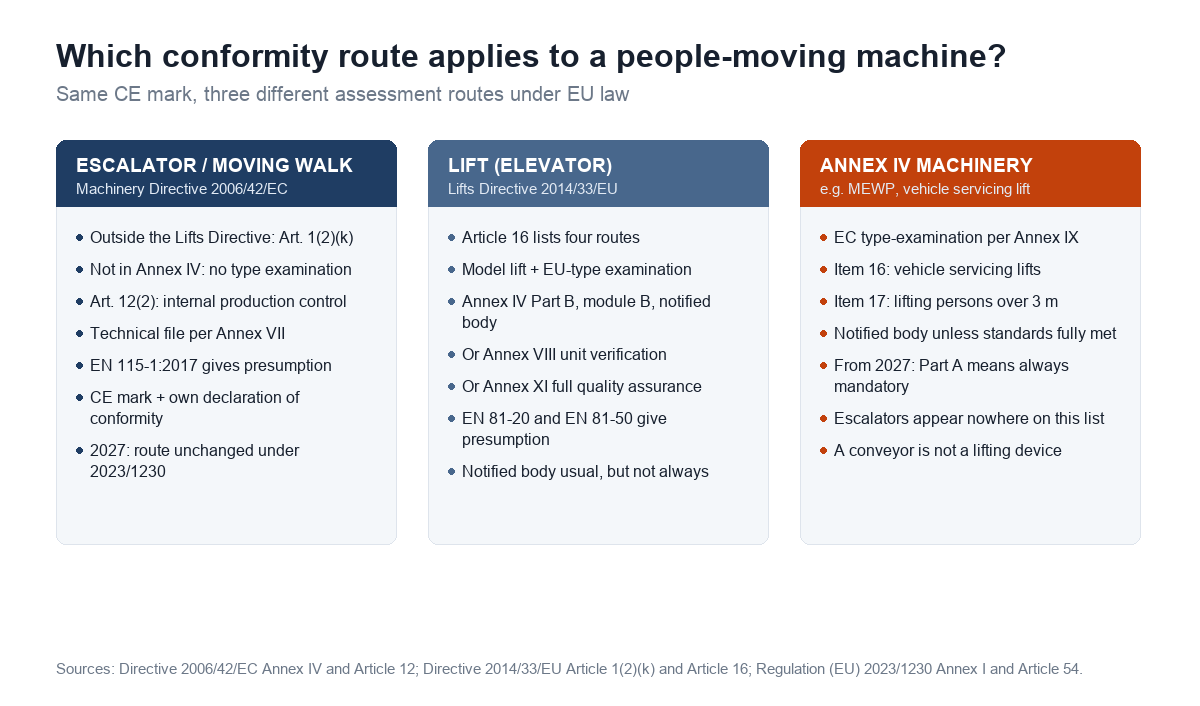
The three routes side by side. An escalator, a lift and an Annex IV machine all reach the CE mark, but only the last two involve a notified body by law.
Because escalators are outside Annex IV, Article 12(2) of the Machinery Directive applies: the manufacturer assesses conformity with internal checks on manufacture. Annex VIII sets out that procedure, and it does not require any third party. The consequence is direct. An escalator type examination is not a legal requirement in the EU, it is not a legal option under the Lifts Directive, and it is not a legal option under Annex IV of the Machinery Directive, because the product is not listed there.
The Conformity Route an Escalator Actually Takes
An escalator manufacturer in China selling into the EU works through four steps. None of them requires an approval body, and all of them leave a paper trail a buyer can check.
Step one: technical file. Annex VII of Directive 2006/42/EC lists what the file must contain: general description, drawings, calculations, test reports, list of standards applied, instructions and, for series manufacture, the internal measures that keep later units identical to the assessed design. An escalator file runs to several hundred pages, and the truss calculation and step chain safety factors are the sections a technical consultant will examine first.
Step two: internal production control. Annex VIII requires the manufacturer to ensure that the units produced conform to the technical file, to keep records, and to sign the declaration. It is a self-assessment with a documentation duty, not an inspection by a third party.
Step three: declaration and CE mark. The EU declaration of conformity follows the model in Annex II 1A and cites the directives and standards applied. The CE mark goes on the machine and in the documents.
Step four: handover documents. Instructions for use, installation drawings, maintenance schedule and the declaration travel with the unit, and the importer keeps a copy for ten years. Read in sequence, these four steps replace an escalator type examination: documentation the manufacturer owns, an assessment the manufacturer performs, and a declaration the manufacturer signs.
| Document | Legal basis | What a buyer should look for |
|---|---|---|
| Technical file | Annex VII | Truss and step calculations, risk assessment, list of standards |
| EU declaration of conformity | Annex II 1A | Directive 2006/42/EC cited, not 2014/33/EU |
| CE mark on the machine | Annex III | Correct proportions, legible, on the truss end or the balustrade panel |
| Instructions for use | Annex I 1.7.4 | Language of the destination country, maintenance intervals |
| Installation drawings | Annex VI | Reaction loads, support points, pit and opening dimensions |
Everything on that list can be checked without a certificate. Ask for the declaration and read which directive it cites. If it cites the Lifts Directive for an escalator, the document was assembled carelessly. If it cites 2006/42/EC and names EN 115-1, the legal basis is correct. Note also that the declaration is issued for the machinery as placed on the market; the site-specific installation checks in EN 115-1 belong to the commissioning stage and are recorded separately.
What EN 115-1:2017 Gives the Manufacturer
Because no escalator type examination applies, the standard carries the whole technical argument. EN 115-1:2017 is the harmonised standard for the construction and installation of escalators and moving walks, prepared by CEN technical committee 10 and cited in the Official Journal under the Machinery Directive. Applying it in full gives presumption of conformity with the essential health and safety requirements the directive sets for this type of machine.
Presumption is a narrower idea than approval. It shifts the burden: a manufacturer who follows the standard is presumed to meet the requirements, and a buyer or authority who disagrees has to show where the standard falls short. Citation dates move for lift standards in a way they have not for EN 115-1, which is why the lift standard changed number while the escalator standard did not.
A manufacturer who departs from the standard is not automatically non-compliant, but must demonstrate in the technical file that the alternative design reaches an equivalent level of safety. That demonstration is exactly where thin files fail, and it is where the difference between a serious exporter and a trading company becomes visible. Neither an escalator nor a moving walk needs an escalator type examination, and the standard is the reason the question rarely arises in a well-run project.
Two practical points are routinely missed in escalator type examination enquiries. EN 115-1 covers new units; existing installations are addressed by a separate part of the same series, so a modernisation project does not simply reuse the new-build file. And the horizontal version of the product, the moving walk, follows the same standard but different clause values for slope and pallet design, which is why moving walk vs escalator choices change the technical file rather than only the price.
When a Notified Body Is Genuinely Involved
Four situations put a third party into an escalator project. Recognising which one you are in tells you what the certificate in front of you is actually worth.
1. A safety component is sold separately. This is the case with real legal force. Annex IV of the Machinery Directive lists protective devices that detect persons (item 19) and logic units that ensure safety functions (item 21). A programmable safety controller for an escalator, placed on the market as a separate component with its own CE mark, falls inside that list and needs the Annex IX procedure.
The escalator itself does not, but the safety board inside its control cabinet might, which is why the controller supplier should be asked for its own certificate rather than the escalator builder being asked for one. The builder cannot convert a component certificate into an escalator type examination for the finished machine.
2. The contract requires it. Project specifications, insurers, lenders and consultants frequently demand an independent certificate. This is a commercial condition, not a legal one, and it should be priced as such instead of being presented as a statutory requirement. Calling it an escalator type examination does not change its legal status.
3. The destination country requires it. Markets outside the EU run their own conformity systems, and some accept an EU-type report as evidence inside a local approval. A certificate obtained for a Gulf or Southeast Asian approval is doing work for that market, not for the CE mark, and it should not be filed as an escalator type examination for Europe.
4. The machine is not really an escalator. A passenger lift, a platform lift, a stage lift or a vehicle lift in the same shipment follows a different route, and the notified body question belongs to those units. Mixing them into one escalator type examination discussion is how quotations get confused.
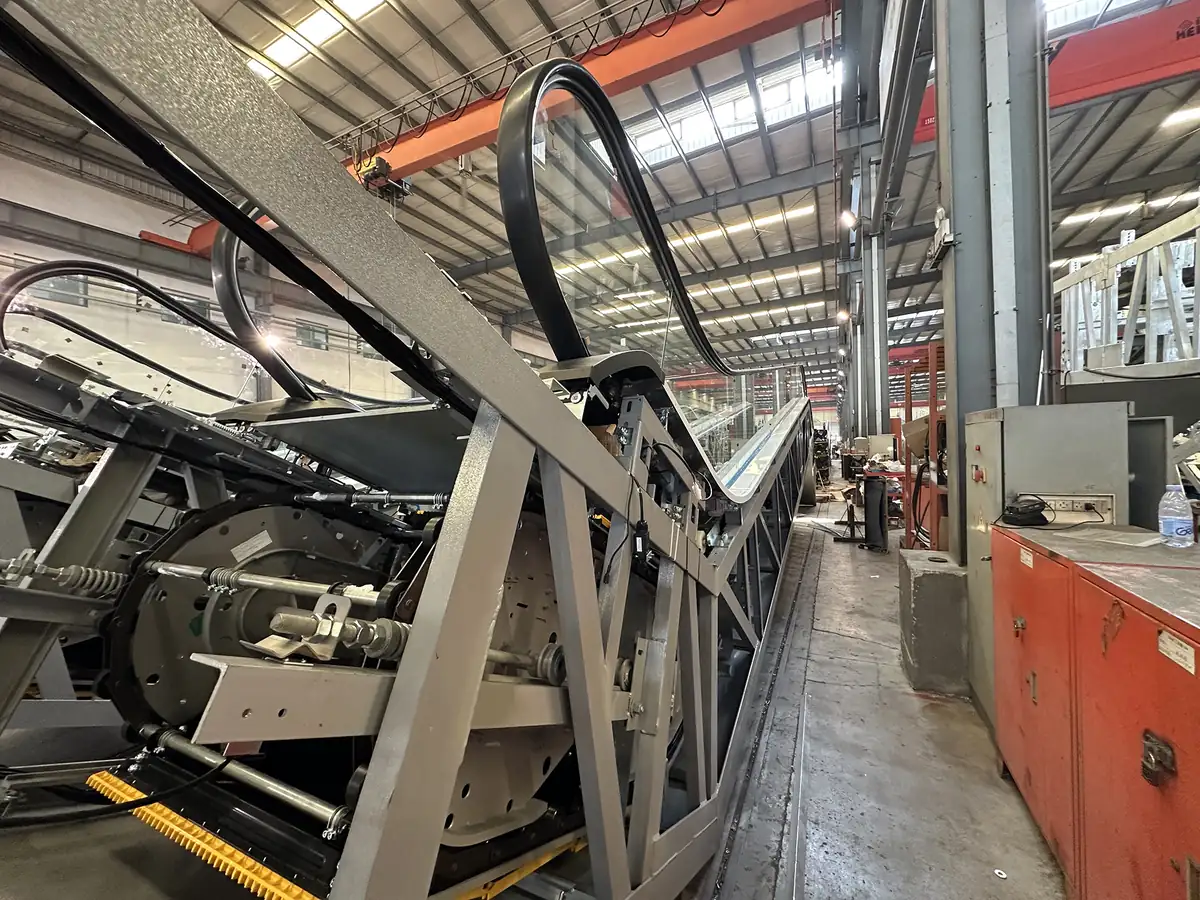
Truss, step chain and comb plate assembled at the BST Express Elevator works. The conformity evidence for a unit like this is the technical file behind it, not a certificate from a lift project.
For the mechanics of choosing and auditing a body when one is genuinely needed, the seven mistakes listed in notified body for elevators apply unchanged to escalator components.
What a Voluntary Third-Party Certificate Proves
Many Chinese escalator factories hold certificates from testing houses, and many of those certificates are genuinely useful. The problem is what buyers assume they mean. A voluntary certificate normally states that a sample was examined against a named standard. It is not the same document as an EU-type examination certificate issued under a directive, and the European Commission has been explicit that private certification cannot substitute for the conformity assessment the law requires.
Three questions separate the two, and they also establish whether the number on the page corresponds to an escalator type examination issued anywhere at all. Was the issuing body notified for this product area, and does its identification number appear in the Commission database? Does the certificate cite an annex of a directive, or only a standard? Does it cover the model you are buying, with the same truss height, step width and safety circuit, or a different one?
A useful rule for procurement: a voluntary certificate is a quality signal and a marketing document, so treat it as supporting evidence. The conformity evidence is the declaration of conformity plus the technical file, and no escalator type examination certificate can replace either of them, because the procedure does not exist for this product.
From 20 January 2027 the Rules Become a Regulation
The Machinery Directive is replaced by Regulation (EU) 2023/1230. Article 54 sets the application date at 20 January 2027, and Article 51(2) repeals Directive 2006/42/EC with effect from the same day. The date as first printed in the Official Journal was 14 January 2027; a corrigendum published on 4 July 2023 in OJ L 169 corrected it, along with thirteen other dates in the same Regulation, to 20 January. EUR-Lex serves the uncorrected base text unless the corrigendum is opened separately, which is why the older date still appears in a great deal of published guidance. Any machine placed on the EU market after that date is assessed under the regulation.
The architecture changes in a way that matters to anyone who has followed the Annex IV argument. The high-risk list becomes Annex I and splits into two parts. Part A contains six categories, including vehicle servicing lifts, cartridge-operated fixing tools, removable transmission devices and the new machine-learning safety components; for those, Article 25(2) leaves no self-assessment option. Part B contains the rest of the previous dangerous list, and Article 25(3) allows internal production control for them. Machinery outside Annex I altogether is covered by Article 25(4), which points to internal production control alone.
| 2006/42/EC until 13 Jan 2027 | 2023/1230 from 14 Jan 2027 | |
|---|---|---|
| Escalator position | Outside Annex IV | Outside Annex I, both parts |
| Assessment for escalators | Article 12(2): internal checks, Annex VIII | Article 25(4): internal production control, Annex VI |
| Notified body for escalators | Not required | Still not required |
| Vehicle lifts and similar | Annex IV item 16, self-assessment possible if standards met | Part A, notified body mandatory |
| Lifting persons above 3 m | Annex IV item 17 | Part B, item 14 |
For escalators the practical result is continuity: the escalator type examination question does not change on 20 January 2027. The regulation adds obligations around digital documentation and software, and a control cabinet containing safety software should be checked against the new provisions before 2027, but the assessment route stays where it is. A supplier who tells you that escalators will need a notified body, or an escalator type examination, from 2027 is describing the vehicle-lift change and misapplying it.
What to Ask a Supplier Before You Sign
Ten items cover the conformity question completely, and none of them is a certificate for an escalator type examination. If a row cannot be answered, a certificate will not fill the gap.
| # | Ask for | What a correct answer looks like |
|---|---|---|
| 1 | EU declaration of conformity | Cites 2006/42/EC, not 2014/33/EU |
| 2 | Standards applied | EN 115-1:2017 named with the edition year |
| 3 | Technical file index | Truss, step chain and brake calculations listed |
| 4 | Risk assessment | Hazards mapped to clauses, not a generic template |
| 5 | Safety controller evidence | Separate certificate for the logic unit, if sold as a component |
| 6 | CE mark placement | Photograph of the actual position on the machine |
| 7 | Instructions language | Language of the destination market, complete |
| 8 | Commissioning checklist | EN 115-1 site tests listed with acceptance values |
| 9 | Change control | How a design change is reflected in the file |
| 10 | Third-party reports | Clearly labelled voluntary, with scope and model number |
How BST Express Elevator Documents the Route
BST Express Elevator ships escalators and moving walks from Suzhou under the Machinery Directive route described above, with EN 115-1:2017 as the design standard. Every order leaves with a technical file, an EU declaration of conformity citing 2006/42/EC, and a commissioning checklist for the installation team.
Three details matter when the equipment arrives. The declaration names the directive and the standard edition, so it can be checked in one minute. The technical file is kept for ten years and is available to a market surveillance authority on request. And the safety controller carries its own component certificate, because that is the one part of an escalator where a third-party examination genuinely attaches. No escalator type examination is quoted as a line item, because there is nothing of that kind to buy.
If a project specification still asks for an escalator type examination, send the clause to BST Express Elevator before the quotation is fixed. In most cases the requirement is a translation of a lift specification, and the correct answer is a clarification letter plus the technical file rather than a certificate nobody can issue. Order escalators and moving walks from the escalator range, and the conformity pack is prepared before the crate is packed.
Frequently Asked Questions
Does an escalator need an EU-type examination?
No. Escalators and moving walks are excluded from the Lifts Directive by Article 1(2)(k) and are not listed in Annex IV of the Machinery Directive, so no EU-type examination applies. Conformity is assessed by the manufacturer through internal production control.
Where does the term EC type-examination come from?
From Directive 95/16/EC, the lift directive that was replaced in 2014. The current Lifts Directive uses EU-type examination instead. The Machinery Directive still uses EC type-examination, but only for the dangerous categories in Annex IV, which exclude escalators.
Can anyone issue an escalator type examination certificate?
Not in the EU sense of the term. A testing house can issue a voluntary report against EN 115-1, and a notified body can carry out a type examination of an escalator safety component under Annex IV of the Machinery Directive. Neither is an escalator type examination of the finished machine, and neither can be issued under the Lifts Directive, which does not cover the product.
Is a third-party certificate required for customs clearance?
No EU customs authority requires an escalator type examination. What is required is the CE mark, the declaration of conformity and the technical file. Some destination countries outside the EU ask for additional approval, which is a separate process with its own documents.
What changes for escalators on 20 January 2027?
The regulation replaces the directive on that date, and escalators remain outside both parts of Annex I. The assessment route stays internal production control, so no escalator type examination appears. Obligations on digital documentation and software inside safety functions are the parts worth reviewing early.
What about the moving walk in the same order?
A moving walk follows the same legal route as an escalator, and the same harmonised standard, but different clause values for slope, pallet width and handrail speed. The moving walk dimensions differ from an escalator of the same rise and change the technical file, so the two models should be documented separately even when they ship together.
How do I check an exporter before ordering?
Read the declaration of conformity, confirm the directive it cites, ask for the standard edition and the technical file index, and query the safety controller certificate separately. The screening steps set out in the guide on how to choose an escalator manufacturer in China apply here without modification.
Send the project specification and the destination country to BST Express Elevator and the conformity documents are mapped against it before the quotation is issued. Where a specification asks for an escalator type examination, the answer is a clause-by-clause reply that shows which directive governs which machine, not a certificate from another product category.
[…] more than one market is involved. Where a project needs elevator CE certification for the lifts and machinery-framework approval for the escalators, expect two separate document sets. Our elevator manufacturing profile lists the CE-certified […]
[…] stage on both product lines. The ISO standards framework and the EN 115-1 test regime set the conformity work that has to be completed before dispatch, and that work is scheduled from the drawing approval […]