


A hospital lift is sized around a stretcher, not around a cabin finish. When you buy from a China hospital elevator supplier, the specification that decides whether the installation works is the one you cannot change after the container sails: the internal car dimensions, the clear width of the landing door, and the accuracy with which the car stops level with the floor. Everything else – the handrail colour, the ceiling, the ventilation – can be adjusted later. Those three cannot, and any China hospital elevator supplier that treats them as options has not understood the product.
This guide is the specification side of hospital lift sourcing. It covers the stretcher and bed dimensions you have to design around, how to check a car size rather than trusting a capacity figure, why the door is usually the real constraint, and the twelve items that belong in a request for quotation before any supplier gives you a price. It is written for importers, contractors and facility teams who are buying hospital elevators from a Chinese factory for the first time, or who have been caught once by a car that was nominally the right size and practically too small.
What a China Hospital Elevator Supplier Actually Sells You
A hospital elevator is not a passenger lift with a handrail added, and a supplier that treats it that way will produce a unit that fails on the first patient transfer. Stretcher traffic imposes three requirements that ordinary passenger traffic does not. The car has to accept a wheeled stretcher at an angle, not just a standing passenger. The door has to pass the stretcher and the attendant without a scrape. And the car has to stop level enough that a loaded trolley crosses the sill without a jolt.
None of that is a finishing detail. All three are fixed at the drawing stage, which is why the specification conversation matters more than the price conversation. The practical output of a competent China hospital elevator supplier is a set of drawings that show exactly which stretchers the lift accepts, confirmed before the deposit. If a quotation arrives as a table of capacities with no car drawing attached, the specification work has not been done yet.
For buyers new to the product line, the hospital elevator range page shows the standard configurations, and everything below is the detail a China hospital elevator supplier should be able to confirm in writing before the order is placed.
Stretcher, Bed and Trolley Dimensions to Design Around
Design to the widest object that will ever cross the sill, not to the average, and settle that dimension with the China hospital elevator supplier before the car size is fixed. Hospital lifts in service carry four different wheeled loads, and they are not the same size. The table below uses the dimensions that international projects work to; individual hospitals may hold stretchers outside these ranges, so confirm the actual inventory with the China hospital elevator supplier before the order is placed.
| Wheeled load | Typical length | Typical width | What to watch |
|---|---|---|---|
| Ambulance stretcher | 1900-2000 mm | 550-650 mm | Narrowest in width, longest in proportion. Folding undercarriage and side rails add height, not width. |
| Patient trolley / gurney | 1900-2100 mm | 700-800 mm | Drip stands and monitor brackets project sideways. Treat the usable width as 850 mm. |
| Manual hospital bed | 2000-2100 mm | 900-1000 mm | With both side rails up, the working width is closer to 1050 mm. |
| Electric hospital bed | up to 2200 mm | 1000 mm | Actuator housings and footboards extend the length. Measure the deployed bed, not the frame. |
The bed is the number that catches projects out, and it is the first figure a China hospital elevator supplier should ask for. A stretcher is long and narrow; a modern electric bed is long and wide, and it is the bed that has to pass through the landing door on the way in. A car sized against a stretcher alone will accept the ambulance trolley and refuse the bed, which is the load the hospital uses every day. BST Express Elevator sizes hospital cars against the bed first and the stretcher second, because the bed is the harder fit.
Check the Car Diagonal, Not Just the Floor Area
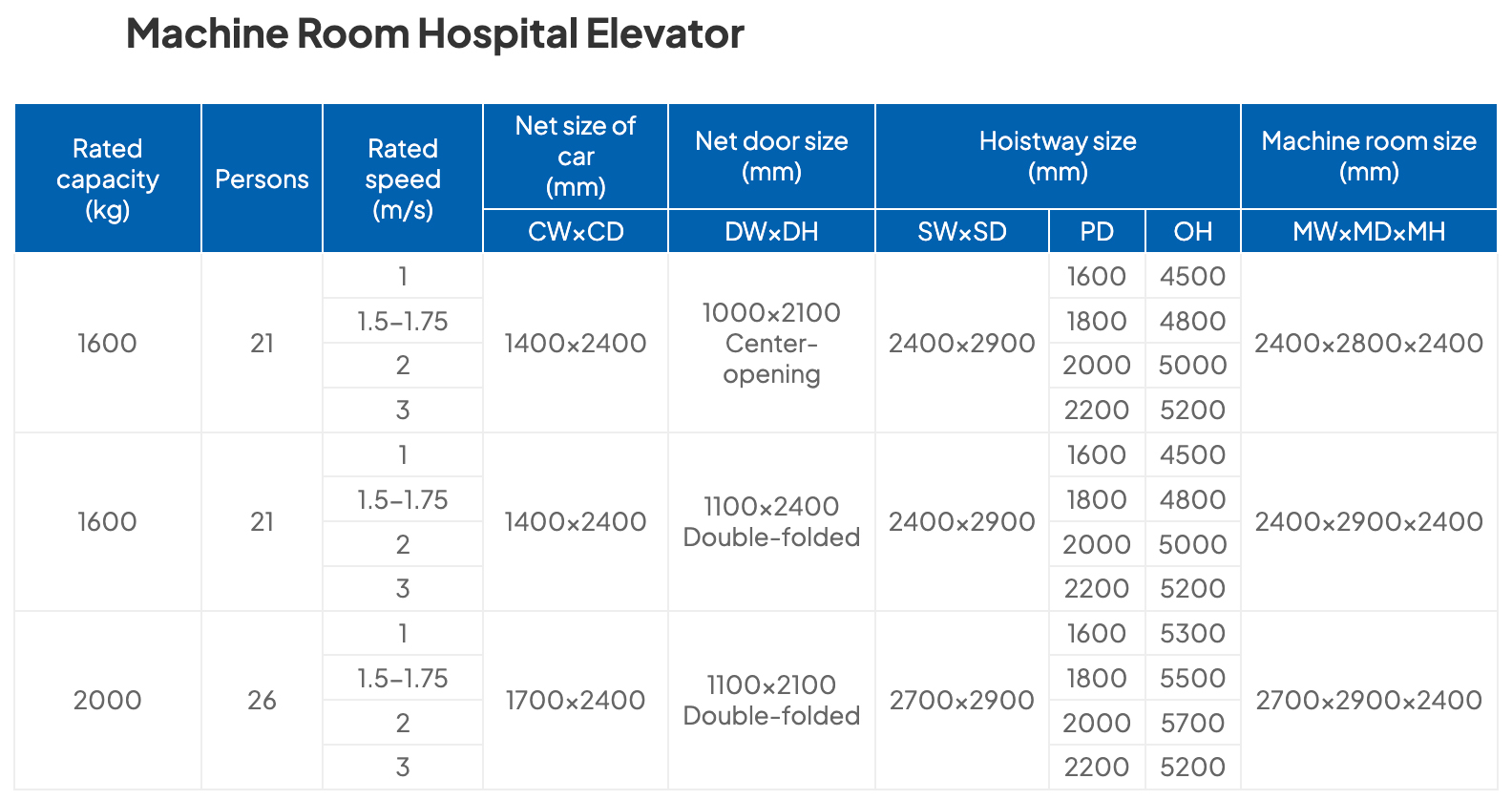
A China hospital elevator supplier quotes car size as internal width by internal depth, written CW x CD. A 1600 kg hospital lift commonly provides 1400 x 2400 mm and a 2000 kg unit around 1700 x 2400 mm. The depth is generous because the stretcher goes in lengthwise, and the width is the dimension that has to clear the trolley plus the person pushing it.
Two checks decide whether a quoted car works.
- The entrance diagonal. The stretcher enters at a shallow angle before it straightens up inside the car. The clear opening of the door has to exceed the diagonal of the loaded trolley across its own footprint, which for a 2100 x 800 mm trolley is roughly 2247 mm end to end – but only the front corner passes the post at any instant, so what matters is the door width plus the free space immediately behind it. A door narrower than the trolley is a permanent obstruction, whatever the car depth, and a point worth raising with the China hospital elevator supplier before the drawings are frozen.
- The working envelope. Medical staff need to stand beside the head of the stretcher and reach the controls. A car that fits the trolley with 50 mm to spare on each side is technically compliant and practically useless, which is why the working envelope has to come from the China hospital elevator supplier rather than from a capacity table. Allow 200-300 mm of clear space along one side.
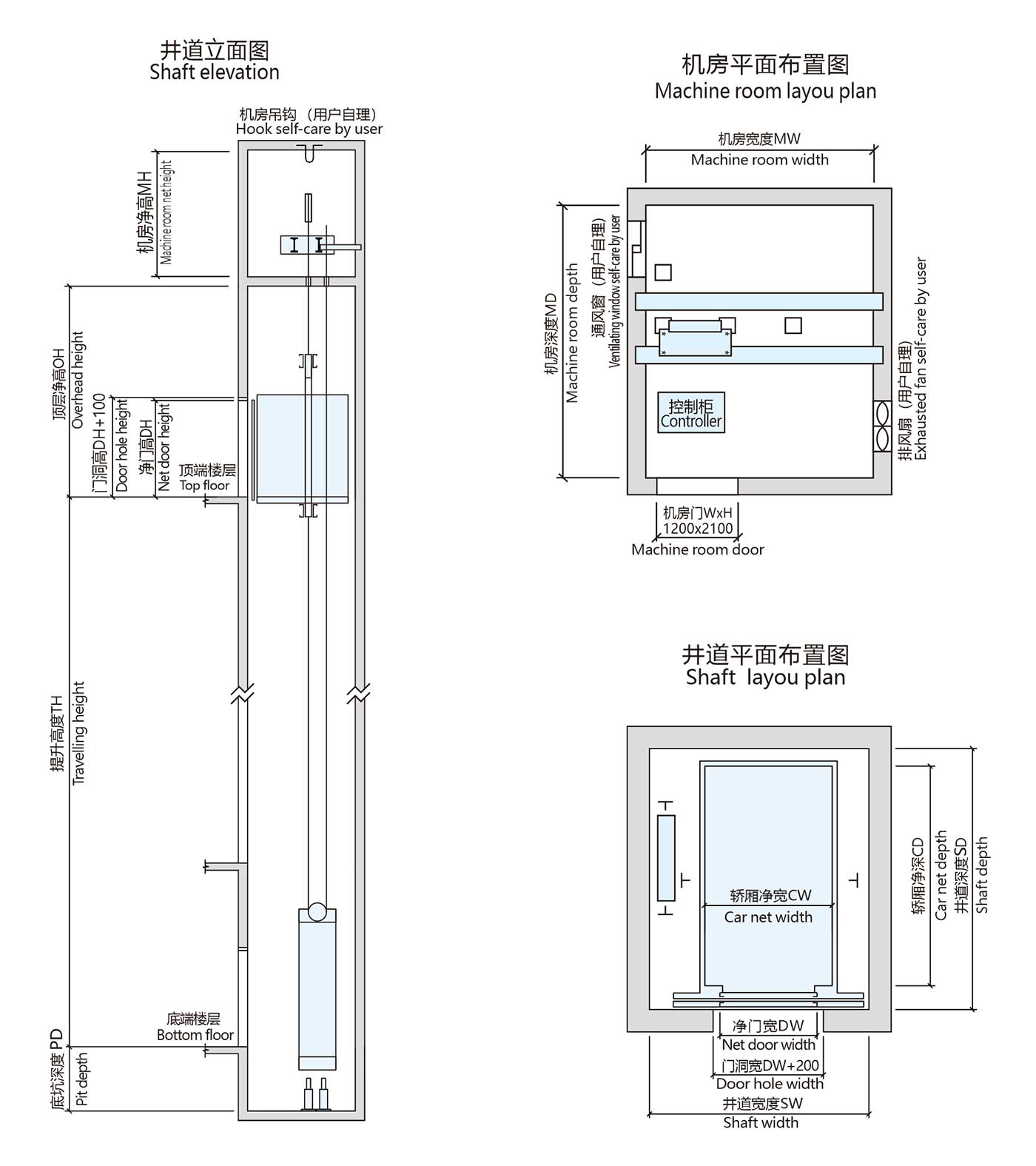
If the ceiling height, pit depth or available shaft volume is the constraint rather than the car itself, the geometry a China hospital elevator supplier works to is set out in the elevator shaft dimensions guide, and the trade-off between car size and capacity is covered in elevator car dimensions and capacity.
Door Clearance Is Usually the Real Bottleneck
Landing door clear width is the first thing to verify on a hospital specification, and it is the dimension a China hospital elevator supplier is most often asked to change after the shaft wall is already built. Standard configurations for hospital duty run from 1000 mm centre-opening to 1100 mm with a double-folded leaf, at a clear height of 2100 mm.
A 1000 mm centre-opening door is adequate for a stretcher and marginal for a bed with rails up, which is the situation a China hospital elevator supplier should flag before you commit to the narrower door. A 1100 mm door passes a 1000 mm bed with 50 mm each side – workable, but the attendant has to be precise. For new build, specify the widest door the shaft will take; the cost difference between a 1000 mm and an 1100 mm door is small, and the difference in daily usability is not.
Three related dimensions are worth fixing with the China hospital elevator supplier at the same time. The clear height of the opening should be at least 2100 mm so that an ambulance stretcher with a raised head section passes without tilting. The landing door and the car door must be mechanically coupled so the patient transfer never meets a mismatch. And the sill gap has to be tight enough that a small trolley wheel cannot drop into it – relevant when the same lift carries equipment carts as well as beds.
Buyers comparing candidate factories will find the door and car figures in the same specification table as the capacity, and comparing them across each China hospital elevator supplier is where the useful differentiation sits. The hospital elevator manufacturer in China comparison covers the factory assessment side; this guide covers what you ask that factory to build.
Levelling Accuracy, Speed and Ride Quality
Levelling tolerance is the measurement a hospital notices, and a China hospital elevator supplier that will not state it in millimetres has not answered the question. A passenger does not register a 10 mm step; a loaded trolley crossing a 10 mm sill does, every time, and nursing staff report it as a fault long before any inspection does. Specify 2 mm levelling and confirm the controller supports it, rather than assuming it from the capacity figure – a question that belongs in the first message to any China hospital elevator supplier.
Speed is chosen from the number of stops and the traffic pattern, not from a preference for a fast lift. Hospital units typically run at 1.0 m/s for low-rise blocks and 1.5 to 1.75 m/s where the bed floors sit above six or seven levels. Acceleration and deceleration curves matter more than the top speed for patient comfort, so ask how the drive ramps rather than only how fast it goes.
Cabin noise should stay below 55 dB in normal running, which is the level at which conversation at the bedside remains easy. BST Express Elevator sets the drive ramp and the levelling tolerance together, because those two decide how a loaded trolley behaves at the sill.
Where only two or three stops exist and the shaft permits, a hydraulic unit remains an option, but for anything taller the geared or gearless traction machine in a passenger elevator frame is the standard platform that hospital variants are built on. Both should be priced by the China hospital elevator supplier against the same shaft before the drive is chosen.
Car Interior Specification for Clinical Use
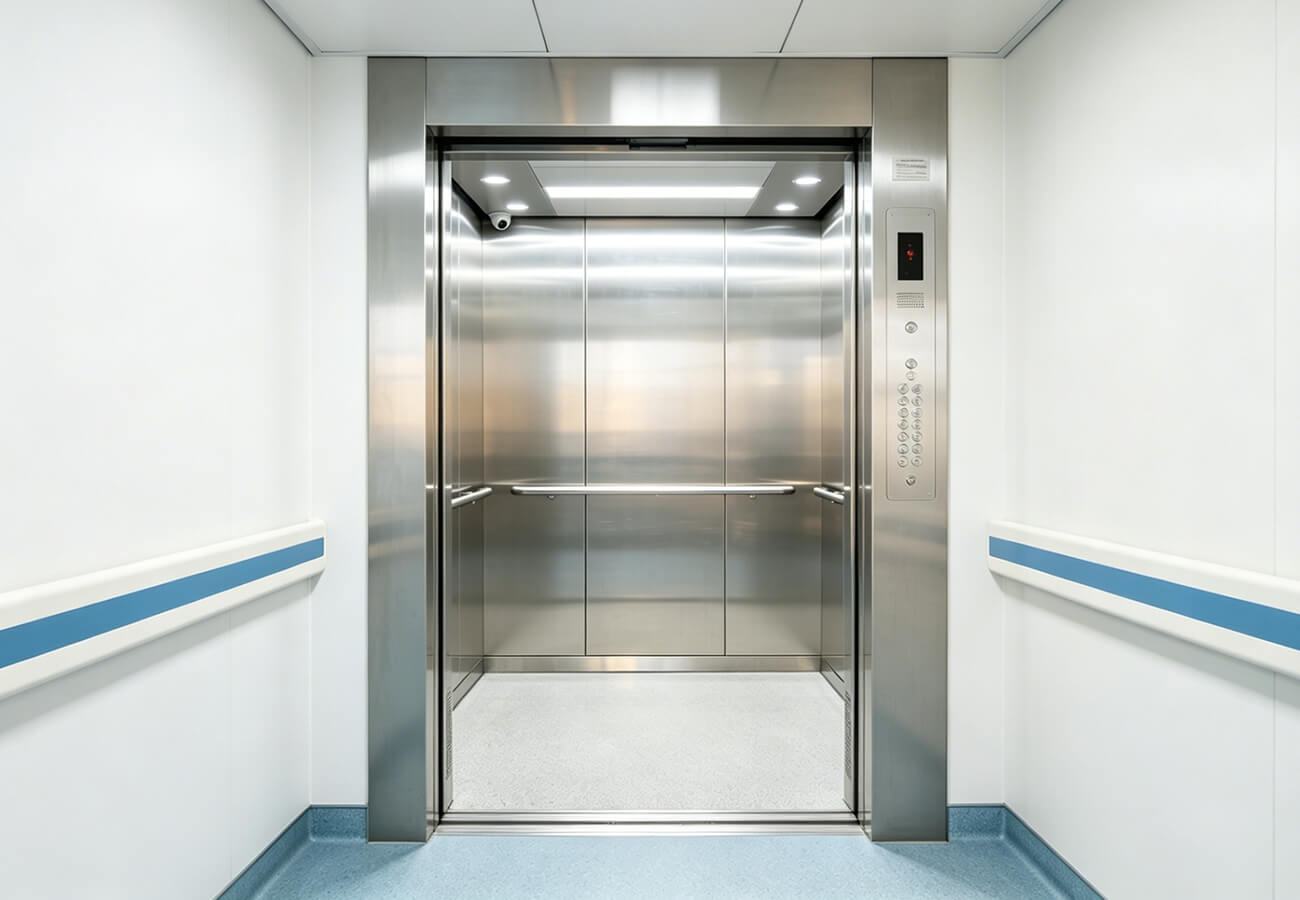
The interior is where hospital lifts differ visibly from passenger lifts, and where a China hospital elevator supplier competing on price usually cuts first. The requirements are practical rather than decorative.
- Three-sided handrails in brushed stainless steel, at 900 mm, so a standing attendant has support while guiding a trolley.
- Impact protection on the lower panels, because a stretcher undercarriage will meet the car wall repeatedly over the life of the lift.
- Seamless flooring with coved edges, so cleaning crews can wash the car floor without water reaching the pan.
- Control panel height set between 900 and 1200 mm with tactile and braille markings, and an audible floor announcement for visually impaired users. The United States Access Board guidance on accessible design is a useful reference for the control layout even in markets that do not adopt it directly.
- Optional clinical additions – ultraviolet or air-purifying units and touchless call buttons – are increasingly specified, but they should never displace the dimensional requirements above in the budget, and a China hospital elevator supplier that leads with them instead of the dimensions has the priorities the wrong way round.
Power Supply, Emergency Levelling and Backup
A hospital lift that strands a loaded trolley between floors is a clinical incident rather than an inconvenience, and it is the failure mode a China hospital elevator supplier has to design out rather than price in. Emergency levelling – the function that drives the car to the nearest floor and opens the doors on mains failure – is mandatory in practice, not optional. Confirm at quotation stage that the controller includes the automatic rescue device with its own battery, and that the battery capacity is stated in minutes rather than described as adequate.
Fire service operation is the other non-negotiable. The lift has to return to the designated evacuation floor on a fire signal and then be usable under firefighter control. Both functions are wired into the controller and have to be specified with the order; retrofitting them into a Chinese controller after delivery is possible but slow and expensive.
Where a standby generator serves the building, the elevator circuit needs to be on it, and the generator capacity has to cover the starting current of the traction machine, not just its running load. That figure is frequently missed by project teams who size the generator against the building’s lighting and HVAC, and it is worth settling with the China hospital elevator supplier before the electrical package is ordered.
Documents a Hospital Elevator Supplier Must Hand Over
Hospital projects are audited, and the documentation package is part of the product – the part a China hospital elevator supplier is judged on long after the lift is running. A supplier that cannot produce these on request has not finished the job, whatever the lift looks like on site.
- CE type examination certificate for the model being supplied, plus the Declaration of Conformity quoting the same certificate number. The checks that separate a genuine certificate from a decorative one are set out in the elevator CE certification guide.
- Load test report and the safety component certificates for the governor, safety gear and door lock.
- As-built shaft, car and landing drawings, issued after manufacture so they reflect the delivered unit.
- Electrical schematic and controller parameter record.
- Maintenance manual, spare parts list with part numbers, and the material certificates for the stainless steel grades used.
The documentation package BST Express Elevator issues with a hospital lift covers all five items, and the certificate number on the Declaration of Conformity is the same one printed on the type examination certificate.
For buyers in the EU or exporting onward into it, the conformity route runs through a Notified Body, and the certificate is a design approval that has to be verified rather than filed, which is why a China hospital elevator supplier selling into Europe works with a Notified Body rather than issuing its own paperwork – see EC-type examination for elevators for what that check involves. The relevant harmonised standards sit with CEN-CENELEC, and the lift safety code in North American practice is published by ASME.
The 12-Point RFQ Checklist for a Hospital Elevator
Send these twelve items with the enquiry, and treat the reply as the first real test of a China hospital elevator supplier. A supplier that answers all of them in the first reply understands hospital products; one that answers five and quotes a price does not.
- Stretcher, trolley and bed dimensions from the hospital’s own inventory, including the widest bed in use.
- Required car internal width and depth, and the number of staff who must stand beside the stretcher.
- Minimum clear landing door width and height.
- Number of stops, travel height and the bed floors in the traffic pattern.
- Rated load and the expected simultaneous load of trolley plus attendants plus equipment.
- Levelling tolerance required, stated in millimetres.
- Speed, and whether the shaft volume allows it.
- Emergency levelling and fire service operation, confirmed as included.
- Supply voltage, frequency and phases, taken from the utility bill of the actual building.
- Interior specification: handrails, impact protection, flooring, control heights, accessibility markings.
- Documentation package, listed item by item.
- Installation arrangement – factory commissioning visit or remote supervision with local labour.
Twelve answers, not twelve prices. A China hospital elevator supplier that returns all twelve in writing has done the engineering; one that returns a price against item five alone has quoted a lift it has not sized.
Comparing Two China Hospital Elevator Suppliers
Two quotes for the same capacity can describe very different lifts, and asking each China hospital elevator supplier the same questions is the only way to see the difference. The comparison that matters is not the headline price but the answers behind the specification.
| What to compare | Weak answer | Strong answer |
|---|---|---|
| Car sizing | A capacity in kilograms | Internal car drawing with the stretcher positioned in it |
| Door | Standard door, width not stated | Clear opening width and height, with the door type named |
| Certification | A CE logo on the brochure | Certificate number, issuing body and the covered model range |
| Drawings | A generic brochure layout | Project drawings issued before the deposit and revised after manufacture |
| Spares | Available on request | A part-numbered list with the critical items shipped in the container |
| Installation | You install it | Drawings for local labour plus a commissioning visit and technician training |
The procurement sequence a China hospital elevator supplier expects – factory selection, certification, shipping, customs and installation – is set out in how to buy elevators from China, and the cost structure that sits behind the price is explained in elevator price in China.
Common Mistakes When Buying a Hospital Elevator from China
- Sizing to capacity instead of to the car. Two 1600 kg lifts from two factories can carry the same load in cars of different internal size, and only the car drawing tells you which China hospital elevator supplier has the usable one. The load figure says nothing about whether a bed fits.
- Ignoring the landing door. The door is the hard limit and the expensive one to change. Fix it before the shaft walls are built, not after.
- Using a passenger model with a handrail. A passenger lift narrowed to a hospital duty often loses the levelling tolerance and the door width that made the product usable.
- Filing the certificate without reading it. Ask the China hospital elevator supplier for the certificate number with the quotation, then read it. A certificate that does not name the model being supplied, or was issued by a body no longer notified for the directive, proves nothing at an audit.
- Leaving levelling unspecified. If 2 mm is not written into the order, it is not what you will receive.
- Forgetting the doctor in the car. Every dimension check that ignores the staff standing beside the stretcher optimises for a load that never travels alone.
Buyers weighing a hospital unit against other product lines sometimes find the alternative in the elevator manufacturer and factory overview, which sets out where each range is designed for – hospital duty is not interchangeable with general passenger service, and a China hospital elevator supplier that offers the same car for both has not understood the difference.
Frequently Asked Questions
What size hospital elevator do I need for a stretcher? A 1600 kg unit with a car around 1400 x 2400 mm is the common starting point, with a clear landing door of at least 1000 mm and preferably 1100 mm. What decides it is not the capacity but the widest bed the hospital uses, plus space for an attendant beside the head of the stretcher – so give the China hospital elevator supplier both figures, not just the load.
Can a standard passenger elevator be used as a hospital elevator? It can carry a stretcher, but it usually fails on three points: levelling tolerance, clear door width, and the interior protection needed for wheeled traffic. A hospital specification should be built on a hospital platform rather than adapted downwards from a passenger model, and that is the question that separates a China hospital elevator supplier with hospital experience from one without it.
What levelling accuracy should I specify? 2 mm. Anything above that is felt by a loaded trolley every time it crosses the sill, and nursing teams report it as a fault well before it appears in any inspection record.
Do I need emergency levelling and a battery backup? Yes, for any hospital unit. The automatic rescue device drives the car to the nearest floor and opens the doors when mains power fails, and its battery capacity should be stated in minutes in the quotation rather than left to the brochure.
How do I verify the CE certificate a supplier sends me? Ask the China hospital elevator supplier for the certificate number first, then check that the issuing body is still notified for Directive 2014/33/EU, that the four-digit number matches the legal entity, and that the certificate names the model you are buying rather than a broad family. The Declaration of Conformity must quote the same certificate number.
Working with BST Express Elevator
BST Express Elevator builds hospital lifts in Suzhou against the specification on the order, and issues the car drawing with the stretcher positioned in it before the deposit is paid. The delivered package includes the type examination documentation, as-built drawings, the load test report and a part-numbered spares list, so the certificate and the machine that ships describe the same unit.
Send the hospital’s actual stretcher and bed dimensions with the enquiry and the team will confirm the car size, door width and shaft requirement in return – the twelve-point checklist above is the right format for that first message. Buyers who want the full product and factory background before starting can read more about BST Express Elevator or send the specification through the contact page.
[…] in China, because stretcher turning space is what often gets missed. See our checklist of stretcher and bed sizes to specify before you commit to a car […]
[…] Hospital lifts are sized by the stretcher, not by the passenger count. A 1,600 kg bed lift normally carries a car of about 2,400 x 1,500 mm, which keeps a 2,200 mm stretcher flat and lets staff work at both ends. That depth requirement is why medical elevator shaft dimensions rarely shrink below 2,900 mm of shaft width. Our hospital elevator range covers these sizes in standard and machine-room-less builds. The shaft-side figures a hospital project has to supply with the RFQ are listed in what a hospital lift supplier needs from the shaft. […]
[…] Where hospital work is a regular requirement, it is cheaper to specify a hospital car from the start than to rework a passenger car later. Our hospital elevator range is built around stretcher and bed dimensions, and a hospital car is specified from the bed outwards, so its elevator car dimensions rarely match a standard passenger sheet. The same logic, worked through figure by figure, is in our guide to hospital car sizing against a bed, not a capacity. […]
[…] medical projects the same logic applies: our guide to sizing a hospital lift for stretcher access lists the car, door and shaft figures to fix before a drawing set is […]