


Elevator brands are the names on the nameplate, and that is exactly where the confusion starts: the name on the plate is not always the company that cut the steel. Nine lift categories are engineered by different supply chains, seven global groups dominate high-rise and transit work, and a few hundred factories in China build most of everything else.
This page sorts elevator brands by category, shows which groups are genuinely strong in each one, and explains how to establish who actually manufactures the unit on your quotation. Nothing below is a paid ranking. The only test applied is whether a claim can be checked from a public document.
A brand is a promise about service, liability and spare parts. A manufacturer is a building with machines, welders, a test tower and a quality file. Most procurement mistakes begin when those two things are treated as one, because the same name often covers both — right up to the moment you ask for the factory address.
- What an Elevator Brand Actually Tells You
- The Seven Global Groups at a Glance
- Why an Elevator Brand Name Is Not a Factory Address
- Where the World’s Elevators Are Actually Built
- Elevator Brands by Category
- How to Compare Elevator Brands on Facts, Not Logos
- What Each Brand Tier Is Really Charging You For
- FAQ: Comparing Elevator Brands
What an Elevator Brand Actually Tells You
An elevator brand reliably tells you three things: who answers the phone when a lift stops, which standards the safety file was written against, and how long spare parts are likely to remain available. What it does not tell you is where the equipment was made, or by whom.
Four assumptions that elevator brands do not support:
- The group owns the plant. Global groups license, rebrand and buy complete units from partner factories in the markets they serve, and this is most common in the low-rise and special-purpose categories.
- The components are the group’s own. Gearless machines, door operators, control boards and safety gears come from specialist suppliers who sell to every brand, including the smallest ones.
- The design suits your building. A car engineered for a 40-storey tower is not automatically the right product for a four-stop kitchen lift in a hotel.
- The price reflects the hardware. Part of what a recognised name costs is the service network behind it, and that network only has value where it exists.
Buyers who treat elevator brands as a directory of factories end up comparing prices for equipment that is not the same product. Buyers who treat elevator brands as a directory of service networks, and then ask separately who builds the unit, get quotations that can actually be lined up side by side.
The Seven Global Groups at a Glance
Four groups are usually described as the big four of the industry: Otis, KONE, Schindler and TK Elevator. Three Japanese manufacturers — Hitachi, Mitsubishi Electric and Fujitec — complete the shortlist that consultants tend to name first when elevator brands are compared for a large project. The table below records only facts a buyer can check on the company’s own site or in its annual report.
| Group | Home base | In the lift business since | Known first for |
|---|---|---|---|
| Otis | Farmington, Connecticut, USA | 1853, founded by Elisha Otis | High-rise passenger and observation lifts, deep service networks |
| KONE | Espoo, Finland | 1910 | Machine-room-less passenger lifts, home lifts, moving walks |
| Schindler | Ebikon, Switzerland | 1874 | Escalators, moving walks, tall-building passenger systems |
| TK Elevator | Düsseldorf, Germany | Independent since the 2020 separation from thyssenkrupp | Heavy-duty freight, hospital and industrial lifts |
| Hitachi | Tokyo, Japan | Elevator production began in 1932 | High-speed passenger work, standardised volume projects |
| Mitsubishi Electric | Tokyo, Japan | Elevator production began in 1931 | Premium ride comfort, hospital and observatory lifts |
| Fujitec | Osaka, Japan | 1948 | Elevators and escalators only, mid-rise volume work |
Four of the seven publish group figures. Otis reported US$14.26 billion of net sales in 2024, KONE EUR 11.1 billion, Schindler CHF 11,236 million, and TK Elevator EUR 9.2 billion in fiscal 2024/2025 with around 50,000 employees and 25,000 service technicians. Those numbers describe a capacity to fund a 100-storey project and a twenty-year service contract.
They tell you almost nothing about which of these elevator brands will quote best on a four-stop goods lift. For that question group size is close to irrelevant, and the section on brand tiers below explains what you are actually buying at each level.
Why an Elevator Brand Name Is Not a Factory Address
Names move faster than factories. The clearest recent example is TK Elevator, which became an independent company when thyssenkrupp separated its lift business in 2020. No plant changed hands on the day of the separation; the logo and the reporting line did. Buyers still search for “thyssenkrupp elevator” and land on a company that now trades under a different name, which is why elevator brands and factory names drift apart quietly.
The same pattern runs through every market. Otis was part of United Technologies until it was separated and listed in 2020. Mitsubishi Electric has built lifts since 1931 and now runs the business through a dedicated building-solutions company. Fujitec has stayed a specialist, which is why it appears in far fewer elevator brands lists than its installed base would justify.
Below that layer sits a much larger one: national distributors, installation contractors and building groups that order a complete unit from a factory and put their own name on it. In China this is routine, legal and disclosed — provided the certificate names the real manufacturer. Three documents settle the question faster than any brochure.
- The certificate of conformity, which must name the manufacturer and the address of the plant that built the unit.
- The type-examination certificate for each safety component, which names the component maker rather than the lift brand.
- The packing list and bill of lading, which name the shipper and show which plant the goods left from.
If the name on the brochure and the manufacturer on the certificate are different companies, you are buying from a reseller. That is not automatically a bad outcome: a reseller with an installation team in your city can be the better partner. But the price, the warranty and the parts promise should then be read differently, and buyers who compare elevator brands on price alone usually discover the difference after the deposit.
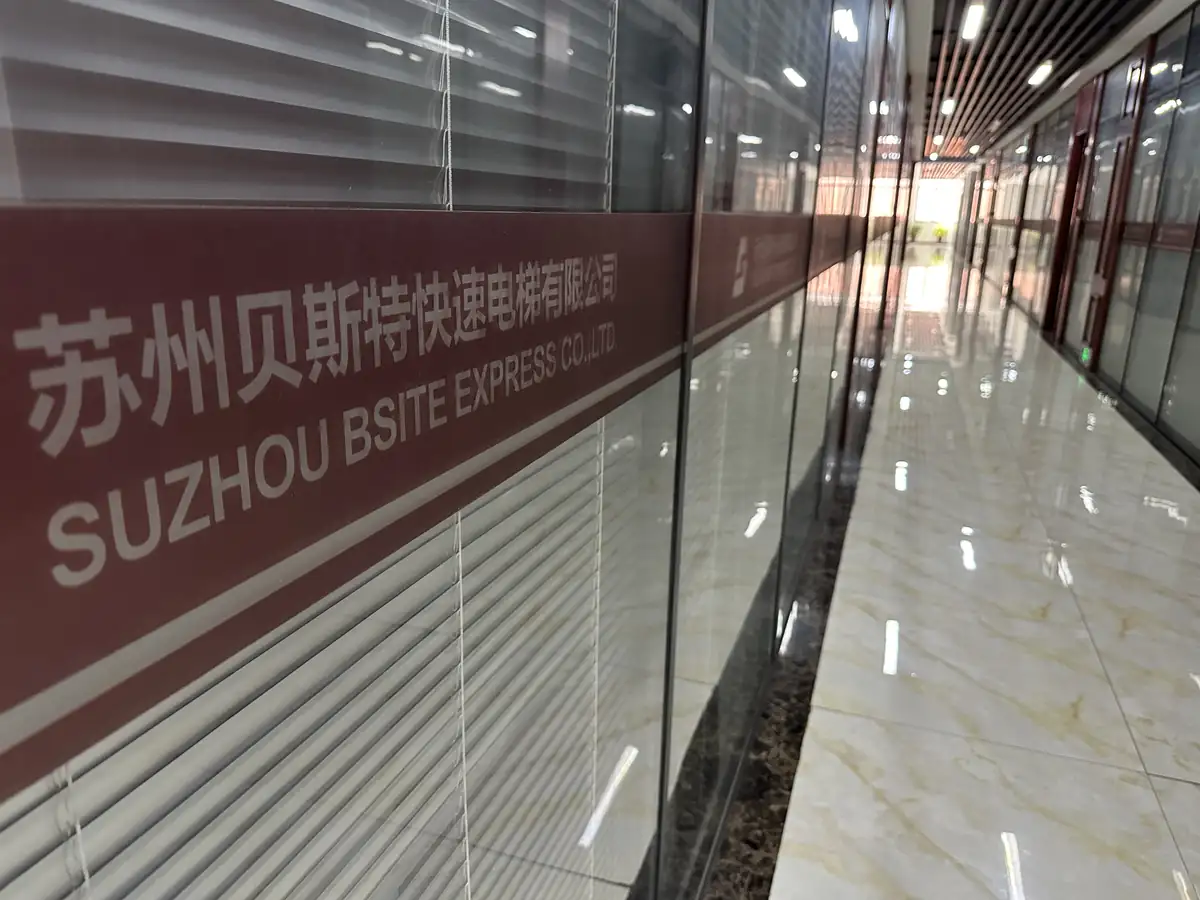
The legal name above the office door at the BST Express Elevator plant in Suzhou. The manufacturer on the certificate of conformity has to match the name on the building, not the name on the brochure.
Where the World’s Elevators Are Actually Built
China is the largest single producing country for lifts and escalators, and output is concentrated in a handful of clusters rather than spread across the map. Zhejiang province alone reported RMB 100 billion of complete-unit and component output in 2024, about 30% of the national total and roughly 20% of global output, according to the provincial market regulator.
Inside Zhejiang, the Nanxun district of Huzhou is one of the country’s three main elevator clusters. After more than 40 years of development it hosts over 300 complete-unit and parts manufacturers, accounts for about 15% of national annual production and sales, and exports to more than 50 countries.
The practical consequence for buyers comparing elevator brands is that one plant can build a domestic-brand lift, a house-brand lift for a European distributor and a unit carrying a global group’s name, all to different specifications. What changes between those three orders is the component list, the documentation set and the inspection regime — not the welding machines.
That is why elevator brands from a cluster deserve to be compared on the specification sheet and the certificates rather than on the brochure. A factory that publishes its drawings and its component list is easier to check than one that publishes only a logo and a showroom.
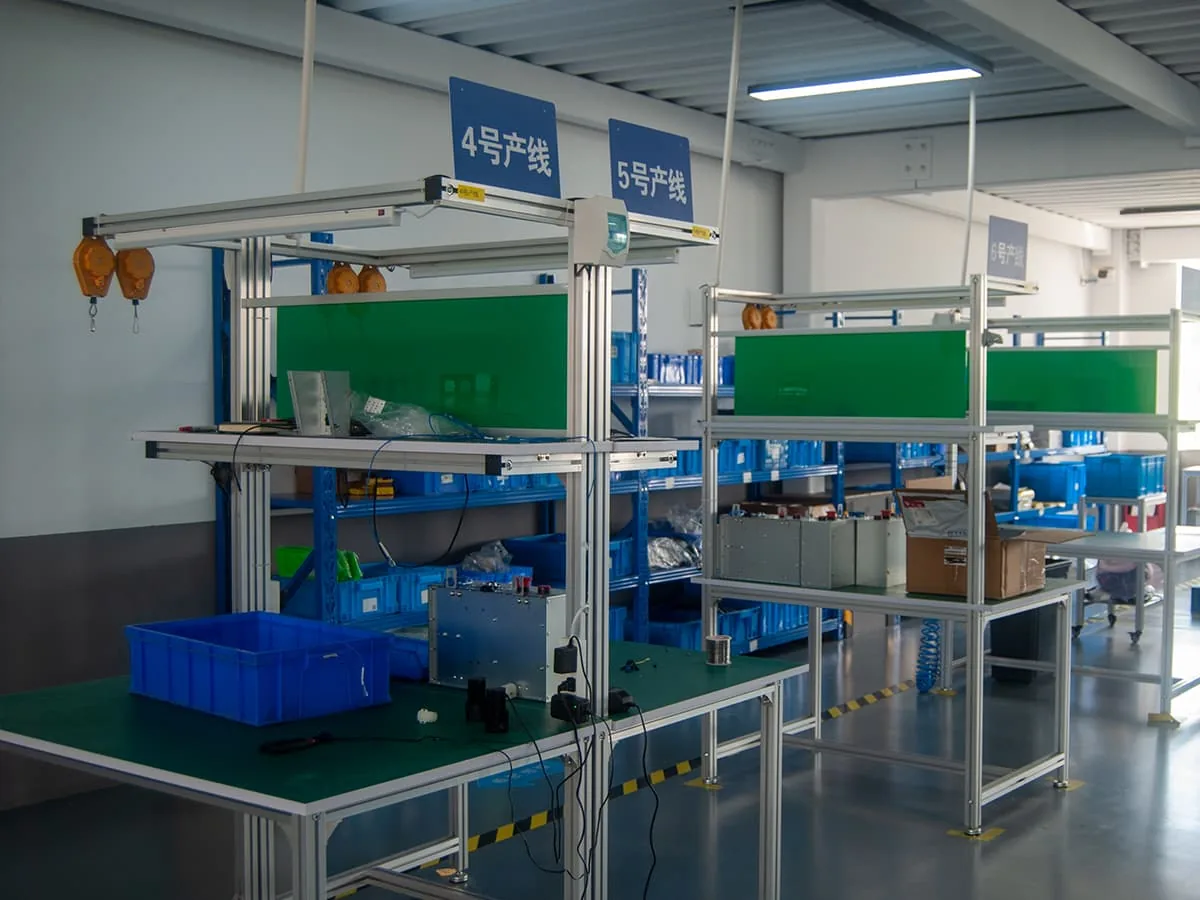
Assembly lines 4, 5 and 6 at the BST Express Elevator plant. Cabinets for different specifications run on the same benches; what separates two orders is the component list, not the line.
Elevator Brands by Category
Each category below has its own technical divide, and that divide decides which elevator brands are credible in it. A group that leads in high-speed passenger work may have no product at all for a kitchen lift. Read the divide first and the names second, and the shortlist usually shortens itself.
| Category | What separates the product | Names most often specified | Where Chinese factories sit |
|---|---|---|---|
| Passenger | Speed and whether there is a machine room; MRL for nearly everything below roughly 2.5 m/s | Otis, KONE, Schindler, Hitachi, Mitsubishi Electric | Volume supplier of MRL passenger lifts |
| Panoramic | How the glass is fixed and how the car is stiffened against wind | Otis, KONE, Hitachi | Strong on curved-glass and semi-outdoor cars |
| Hospital | Bed length, door width, jerk limits and cleanable surfaces | Mitsubishi Electric, TK Elevator, KONE | Bed-sized cars built to project drawings |
| Freight | Rated load, guide-rail strength, door type, loading method | TK Elevator, KONE, Schindler | Main volume category; 1,000-5,000 kg routine |
| Car | Platform structure, pit depth and whether the driver stays in the vehicle | KONE, Otis | Four-post and two-post platforms to order |
| Escalator | Rise and duty cycle, not width | Schindler, KONE, Otis, Hitachi | Commercial units strong; metro duty improving |
| Moving walk | Incline (0° or 12°) and pallet width (800, 1,000, 1,400 mm) | Schindler, KONE, Mitsubishi Electric | Airport and mall pallets, standard widths |
| Dumbwaiter | Drive type and a safety chain that forbids passengers | Specialist factories, not the global groups | The category where Chinese factories lead |
| Home and villa | Shaft as found, drive type, pit depth available | European specialists, global group ranges, factory brands | Glass panoramic MRL home lifts |
1. Passenger Elevator Brands
Passenger lifts divide by speed and by whether there is a machine room. Below roughly 2.5 m/s most projects use gearless machine-room-less equipment, where the machine sits inside the hoistway and the building saves a room it never had to pour. Above that speed, and certainly past 4 m/s, the design returns to a machine room and the shortlist narrows quickly.
The global groups are strongest in the second case, because high-speed work needs test towers, ride-quality engineering and a service organisation in the destination city. Chinese factories are strongest in the first: MRL passenger lifts are the volume product of every cluster, the specification gap at 1.0–1.75 m/s is now small, and the elevator brands sold out of those clusters differ mainly in component list. See how passenger elevator manufacturers in China build and document that volume product.
2. Panoramic Elevator Brands
Panoramic lifts divide on how the glass is fixed and how the car is stiffened against wind. A straight-glass car is a glazed standard cabin; a curved-glass car is a different structure, with a formed frame, laminated glass and a load path that has to be engineered rather than assembled. Semi-outdoor installations add water management to the list.
Otis, KONE and Hitachi are the three elevator brands that appear most often on hotel and landmark projects, where the glass is part of the architecture. For a mid-rise commercial or residential job the same effect is available from cluster factories at a fraction of the price, and panoramic elevator supply from China now covers curved and semi-outdoor cars as standard ranges rather than one-off builds.
3. Hospital Elevator Brands
Hospital lifts divide on the bed. A car has to take a trolley with staff on both sides, which pushes depth towards 2.4 m and door width to 1.2 m or more in most hospital specifications, and the ride has to stay comfortable at low speeds where jerk is felt most. Cleanable surfaces and door times long enough for a trolley finish the list.
Mitsubishi Electric, TK Elevator and KONE are the elevator brands most often written into hospital tenders. The specification, however, is written by the hospital, and a factory that builds bed-sized cars to those drawings will meet it. Compare hospital elevator manufacturers in China on car dimensions and door times before comparing price.
4. Freight Elevator Brands
Freight lifts divide on load and on how goods arrive. A pallet truck, a forklift and a loaded van each demand a different platform, guide-rail section and door. Cars from 1,000 kg to 5,000 kg are routine, above that the structure becomes the design, and the choice between traction and hydraulic drive is decided by travel height and usage rate.
TK Elevator, KONE and Schindler hold the heavy end of the market, largely because industrial clients buy service with the equipment, and those three elevator brands are hard to displace once a plant is running. Chinese factories build most of what ships internationally in this category, and it is the category where freight elevator manufacturers in China compete on specification rather than on name.
5. Car Elevator Brands
Car lifts divide on the platform and on whether the driver stays in the vehicle. A four-post platform carrying a car with occupants needs a different safety chain from a two-post platform loaded empty, and pit depth, headroom and door height are set by the largest vehicle the building expects rather than by an average one.
KONE and Otis are the elevator brands specified most often for dealership and multi-storey parking work. Factory-built platforms are common in this category because the structure is simple to document, and car elevator manufacturers in China quote four-post platforms by platform size and rated load.
6. Escalator Brands
Escalators divide on duty cycle, not on width. A shopping-centre unit and a metro-station unit look alike and are not: transit work means 20 hours of continuous running, heavier loading, outdoor or semi-outdoor environment and a specified maintenance window. Rise sets the geometry; duty sets the components.
Schindler, KONE, Otis and Hitachi dominate transit specifications, and those four elevator brands are written into metro tenders years before the units are ordered. Commercial 30° units are where Chinese factories are most competitive, and the certification route for escalators differs from the lift route, which choosing an escalator manufacturer in China sets out step by step.
7. Moving Walk Brands
Moving walks divide on incline and pallet width. A 0° walk in an airport and a 12° walk in a hypermarket share a mechanism but not a specification, and pallet width — 800, 1,000 or 1,400 mm — decides throughput more than length does. Balustrade type and outdoor rating complete the picture.
Schindler, KONE and Mitsubishi Electric are the elevator brands named most often for airport work. For retail and exhibition use the specification is simpler and the field is wider; choosing a moving walk manufacturer in China covers the incline, width and decking decisions in the order they matter.
8. Dumbwaiter Brands
Dumbwaiters divide on drive and on a safety chain that forbids passengers. Loads run from 50 kg to 300 kg over two to six stops, landings are interlocked, and many units have no car door at all. Traction and hydraulic drives each suit different shaft conditions, and the document that matters is the one showing the interlock and overspeed protection.
The global groups list dumbwaiters as a minor line, so the strongest elevator brands in this category are specialist factories that build nothing else. A buyer comparing them should weight spare-part availability and shaft-drawing turnaround above the logo. One specialist, servlifts.com, publishes its drawings and shaft schedules openly; the category overview on this site’s dumbwaiter page explains where such a unit fits in a building.
9. Home and Villa Elevator Brands
Home lifts divide on the shaft you already have. In a finished house the car size is set by the stairwell void, not by a catalogue, and the drive type follows: screw and hydraulic platforms work with pits of a few centimetres, while traction machine-room-less needs a pit of roughly 300 mm and returns the quietest ride.
European specialists own the premium retrofit market, the global groups offer home ranges, and factory brands fill the middle.
BST Express Elevator builds glass panoramic home lifts with MRL traction in Suzhou, sized to the void a renovation actually offers — its villa range runs 250 kg to 630 kg, against the standard 1,000 kg box most groups quote into a house — and ships them with a shaft drawing package and a CE file. For buyers comparing elevator brands for a villa, that combination — a factory that will re-dimension a car rather than sell a standard box — is usually worth more than a familiar logo. Details are on the residential elevator manufacturer in China page.
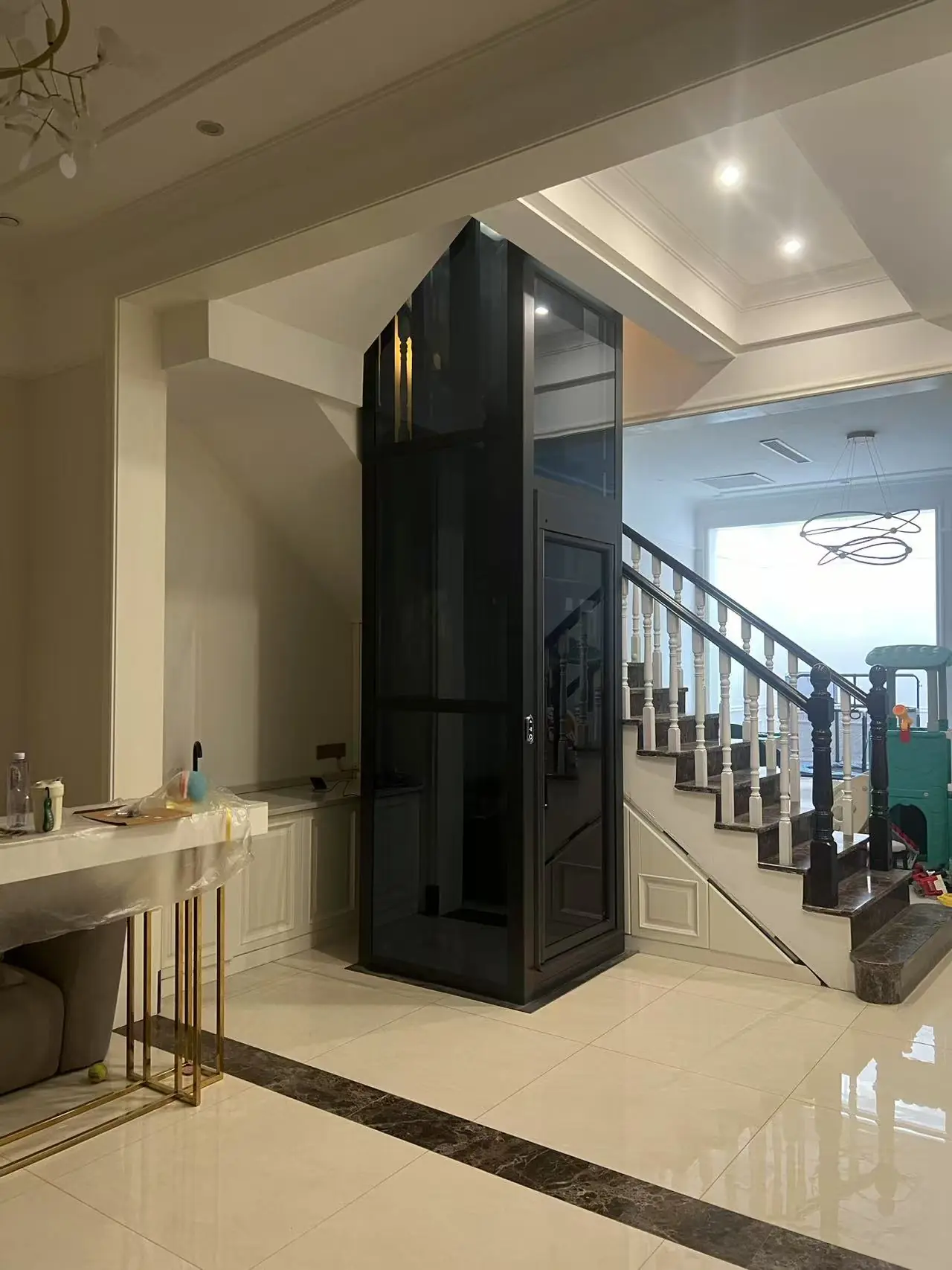
A glass panoramic home lift fitted into an existing stairwell void. The car was sized to the house; the house was not altered to fit a catalogue car.
How to Compare Elevator Brands on Facts, Not Logos
Eight questions separate elevator brands that build from elevator brands that resell, and every one of them has a document behind it. Ask them in the order below: the first three decide whether you are talking to a manufacturer at all, and the rest decide whether the offer is worth the money.
| Question | What a good answer looks like | Warning sign |
|---|---|---|
| Who is the legal manufacturer? | A company name and plant address matching the certificate of conformity | A trading company name and a factory name that never appear on the same document |
| Which safety components are certified? | Type-examination certificates per component, each naming its own maker | One certificate described as covering the whole lift |
| What is the component list? | Machine, door operator, control board, safety gear and wire ropes named by maker and model | Brand names only, no model numbers |
| How long are spare parts held? | A written period, typically 10 years or more, and a named parts list | The answer arrives verbally and is not in the contract |
| What is the test regime? | Load test, safety-gear test, buffer and overspeed test recorded per unit | A factory visit offered instead of test records |
| Who signs the inspection document? | A named body or engineer, with the standard cited | The supplier signs its own acceptance report |
| What is the shipping scope? | Incoterm, port of loading, packing list and container loading plan | Incoterm left blank until the deposit is paid |
| What happens in year six? | A service model, a parts price list and a named contact | A warranty promise with no route to parts |
The point of the table is that none of the answers requires technical expertise to check. A certificate either names a plant or it does not. A parts list either carries model numbers or it does not. Where a supplier answers all eight in writing, the comparison between elevator brands becomes a matter of reading rather than of trusting.
Two of these questions carry more weight than the rest. The manufacturer named on the certificate decides who is legally responsible for the unit, and the spare-part period decides what the sixth year of ownership costs. Both are cheap to confirm before signing and expensive to discover afterwards.
The document trail behind a European order is summarised in elevator CE certification, the body that issued any certificate can be looked up in IAF CertSearch, and the EU notified body register shows whether that body is authorised for lifts. In the UK, the Health and Safety Executive sets the duty that keeps a lift in service legally, and the on-site version of the same audit is set out in how to verify an elevator factory.
What Each Brand Tier Is Really Charging You For
Quotes for the same nominal lift can differ by tens of percent between tiers, and the difference is rarely the steel, which is why elevator brands from different tiers are not interchangeable products. What separates the tiers is who carries the liability, who answers the phone locally, and how much engineering time is spent before production starts.
| Tier | What the price covers | Typical project | One extra step before signing |
|---|---|---|---|
| Global group | Own plants, own service company, global liability, group-level engineering | High-rise, transit, hospital, branded developments | Confirm which plant will build it and which entity services it |
| Regional brand with its own plant | Own factory, domestic service network, limited geographic reach | Mid-rise residential and commercial work | Check the plant exists and see the test tower |
| Distributor or house brand | Someone else’s equipment, local installation and service, the distributor’s name on the brochure | Retrofit, single-building, tender-driven work | Get the manufacturer named on the certificate and in writing |
| Factory brand direct | Equipment, documentation and export packing, without a local service layer | Freight, dumbwaiter, home lift, project supply to a contractor | Confirm who commissions it and who holds the parts |
None of these tiers is better in the abstract. A global group is the rational choice when the building is a landmark, the lender requires a name, or the service obligation runs for two decades. A factory brand is the rational choice when the specification is settled, the buyer has its own installation team, and the money is better spent on components than on a logo.
The mistake to avoid is paying group prices for distributor equipment, which is what happens when the certificate is never read. Price levels for each tier, and the items that move them, are broken down in elevator price in China.
FAQ: Comparing Elevator Brands
Are elevator brands the same as elevator manufacturers?
No. A brand is the name a product is sold under; the manufacturer is the company that holds the certificate of conformity for the unit. Groups, distributors and contractors all sell under brand names, and in the low-rise and special-purpose categories the two are frequently different companies.
Which elevator brands are the largest in the world?
Otis, KONE, Schindler and TK Elevator are normally grouped as the big four, with Hitachi, Mitsubishi Electric and Fujitec behind them. Between them they hold most of the global high-rise and transit market. Size is a fair proxy for service depth and a poor proxy for price on a small project.
Do Chinese elevator brands build to European standards?
Chinese elevator brands that export to the EU build to the Lifts Directive and hold certificates for the safety components they fit. The distinction that matters is whether the export order is engineered to that standard from the start or adapted at the end; the certificate list and the test records show which happened.
How can I tell whether an elevator brand owns a factory?
Ask for the certificate of conformity, the type-examination certificates and the packing list. If the manufacturer named on the certificate is a different company from the brand on the brochure, the brand is a reseller. That is workable, provided the price and warranty reflect it.
Is it risky to choose a factory brand over a global brand?
It is a different risk, not a larger one. A factory brand usually offers more specification for the same money and less local service; a global group offers the reverse. If the building is in a city where the factory brand has no partner, plan for who commissions the lift and who holds spare parts.
Why do quotes for elevator brands differ so much for the same specification?
Because the specification is rarely the same once the component list is compared. Machine type, door operator, control board, cabin finish and the documentation set account for most of the spread. Two quotes can look identical on page one and differ by a whole drive system by page four, and the elevator brands involved are often the least useful part of the comparison.
Which elevator brands are best for a home or villa lift?
For a finished house the constraint is the shaft, so the best choice is whichever brand can fit a workable car into the space that exists. Screw and hydraulic platforms suit shallow pits; MRL traction gives the quietest ride when a pit of about 300 mm can be formed. Compare elevator brands on shaft drawings, not on catalogues.
Should the brand on the nameplate match the brand on the contract?
Yes, and the contract should say so. Write the legal manufacturer’s name, the plant address and the certificate numbers into the agreement. If the nameplate arrives with a different company on it, the documentation no longer supports the warranty, and the spare-parts promise has no owner.
The last word belongs to documents rather than to names. BST Express Elevator builds all eight lift types under one roof in Suzhou — passenger, panoramic, hospital, freight, car, escalator, moving walk and home — covering 400 kg to 2,500 kg and tested to EN 81-20 and EN 81-50, ships them as complete sets, and issues the CE file and shaft drawings before production starts. Buyers still weighing elevator brands can send a shaft drawing or a floor plan and get a dimensional check back before price is discussed — the contact page is the place to start.